---
title: Fix product feeds & tracking before October code freezes.
description: Discover how hybrid manufacturers can optimize Google Manufacturer Center and GA4 tracking before October code freezes to protect Q4 margins.
image: https://blog.dabrianmarketing.com/hubfs/AdobeStock_865888924.jpeg
---
[Get A Quote](https://dabrianmarketing.com/get-a-quote/)
[610.743.5602](tel:+16107435602)
[Schedule A Meeting](https://meetings.hubspot.com/dlaws/?__hstc=98550144.2ad6533e04aa85d8419535b85f8064b9.1588144268754.1588219197863.1588226005683.6&__hssc=98550144.6.1588226005683&__hsfp=47018764)
[](https://dabrianmarketing.com/)
- [About](https://dabrianmarketing.com/about/)
- [Team](https://dabrianmarketing.com/about/team/)
- [Careers](https://dabrianmarketing.com/about/careers/)
- [Work](https://dabrianmarketing.com/about/work/)
- [HubSpot Agency](https://dabrianmarketing.com/hubspot-agency/)
- [Marketing Hub](https://dabrianmarketing.com/hubspot-agency/hubspot-marketing-hub/)
- [Setup & Strategy](https://dabrianmarketing.com/hubspot-agency/hubspot-marketing-hub/hubspot-foundational-marketing-services/)
- [Traffic Generation](https://dabrianmarketing.com/hubspot-agency/hubspot-marketing-hub/traffic-generation/)
- [Lead Conversion](https://dabrianmarketing.com/hubspot-agency/hubspot-marketing-hub/lead-conversion/)
- [Lead Nurturing](https://dabrianmarketing.com/hubspot-agency/hubspot-marketing-hub/lead-nurturing/)
- [Sales hub](https://dabrianmarketing.com/hubspot-agency/hubspot-sales-hub/)
- [CRM Implementation](https://dabrianmarketing.com/hubspot-agency/hubspot-sales-hub/crm-implementation/)
- [Sales Enablement](https://dabrianmarketing.com/hubspot-agency/hubspot-sales-hub/sales-enablement/)
- [Sales & Marketing Alignment](https://dabrianmarketing.com/hubspot-agency/hubspot-sales-hub/sales-marketing-alignment/)
- [Content Hub](https://dabrianmarketing.com/website-design/centralize-personalize-optimize-your-content-with-hubspot-content-hub/)
- [Digital Marketing](https://dabrianmarketing.com/digital-marketing/)
- [Inbound Marketing](https://dabrianmarketing.com/digital-marketing/inbound-marketing/)
- [Content Marketing](https://dabrianmarketing.com/digital-marketing/content-marketing/)
- [Email Marketing](https://dabrianmarketing.com/digital-marketing/email-marketing/)
- [SEO](https://dabrianmarketing.com/digital-marketing/seo/)
- [Social Media Marketing](https://dabrianmarketing.com/digital-marketing/social-media-marketing/)
- [PPC Management](https://dabrianmarketing.com/digital-marketing/ppc-advertising/)
- [Digital Analytics](https://dabrianmarketing.com/digital-analytics/)
- [Web Design](https://dabrianmarketing.com/web-design/)
- [Shopify Web Design](https://dabrianmarketing.com/website-design/build-a-shopify-store-that-sells-more/)
- [CMS Hub](https://dabrianmarketing.com/website-design/centralize-personalize-optimize-your-content-with-hubspot-content-hub/)
- [Branding/Graphic Design](https://dabrianmarketing.com/branding/)
- [Our Work](https://dabrianmarketing.com/web-design/our-work/)
- [Hosting & Maintenance](https://dabrianmarketing.com/web-design/hosting-maintenance/)
- [Blog](https://blog.dabrianmarketing.com/)
- [Small & Mid-Sized Business Resources](https://dabrianmarketing.com/resources/)
- [Client Referral Program](https://dabrianmarketing.com/client-referral-program-2023-2024/)
- [About](https://dabrianmarketing.com/about/)
- [Team](https://dabrianmarketing.com/about/team/)
- [Careers](https://dabrianmarketing.com/about/careers/)
- [Work](https://dabrianmarketing.com/about/work/)
- [HubSpot Agency](https://dabrianmarketing.com/hubspot-agency/)
- [Marketing Hub](https://dabrianmarketing.com/hubspot-agency/hubspot-marketing-hub/)
- [Setup & Strategy](https://dabrianmarketing.com/hubspot-agency/hubspot-marketing-hub/hubspot-foundational-marketing-services/)
- [Traffic Generation](https://dabrianmarketing.com/hubspot-agency/hubspot-marketing-hub/traffic-generation/)
- [Lead Conversion](https://dabrianmarketing.com/hubspot-agency/hubspot-marketing-hub/lead-conversion/)
- [Lead Nurturing](https://dabrianmarketing.com/hubspot-agency/hubspot-marketing-hub/lead-nurturing/)
- [Sales hub](https://dabrianmarketing.com/hubspot-agency/hubspot-sales-hub/)
- [CRM Implementation](https://dabrianmarketing.com/hubspot-agency/hubspot-sales-hub/crm-implementation/)
- [Sales Enablement](https://dabrianmarketing.com/hubspot-agency/hubspot-sales-hub/sales-enablement/)
- [Sales & Marketing Alignment](https://dabrianmarketing.com/hubspot-agency/hubspot-sales-hub/sales-marketing-alignment/)
- [Content Hub](https://dabrianmarketing.com/website-design/centralize-personalize-optimize-your-content-with-hubspot-content-hub/)
- [Digital Marketing](https://dabrianmarketing.com/digital-marketing/)
- [Inbound Marketing](https://dabrianmarketing.com/digital-marketing/inbound-marketing/)
- [Content Marketing](https://dabrianmarketing.com/digital-marketing/content-marketing/)
- [Email Marketing](https://dabrianmarketing.com/digital-marketing/email-marketing/)
- [SEO](https://dabrianmarketing.com/digital-marketing/seo/)
- [Social Media Marketing](https://dabrianmarketing.com/digital-marketing/social-media-marketing/)
- [PPC Management](https://dabrianmarketing.com/digital-marketing/ppc-advertising/)
- [Digital Analytics](https://dabrianmarketing.com/digital-analytics/)
- [Web Design](https://dabrianmarketing.com/web-design/)
- [Shopify Web Design](https://dabrianmarketing.com/website-design/build-a-shopify-store-that-sells-more/)
- [CMS Hub](https://dabrianmarketing.com/website-design/centralize-personalize-optimize-your-content-with-hubspot-content-hub/)
- [Branding/Graphic Design](https://dabrianmarketing.com/branding/)
- [Our Work](https://dabrianmarketing.com/web-design/our-work/)
- [Hosting & Maintenance](https://dabrianmarketing.com/web-design/hosting-maintenance/)
- [Blog](https://blog.dabrianmarketing.com/)
- [Small & Mid-Sized Business Resources](https://dabrianmarketing.com/resources/)
- [Client Referral Program](https://dabrianmarketing.com/client-referral-program-2023-2024/)
[Get A Quote](https://dabrianmarketing.com/get-a-quote/)
[610.743.5602](tel:+16107435602)
416 Blair Ave,
Reading, PA 19601
[](https://dabrianmarketing.com/)
[Schedule A Meeting](https://meetings.hubspot.com/dlaws/?__hstc=98550144.2ad6533e04aa85d8419535b85f8064b9.1588144268754.1588219197863.1588226005683.6&__hssc=98550144.6.1588226005683&__hsfp=47018764)
# How Hybrid Manufacturers Take Control of Google Product Data Before Q4
August 3, 2026 by [Dabrian Marketing Group](https://blog.dabrianmarketing.com/author/dabrian-marketing-group) [Leave a Comment](https://blog.dabrianmarketing.com/fix-product-feeds-tracking-before-october-code-freezes#blog-comments)
- [Share](http://www.facebook.com/sharer/sharer.php?u=https://blog.dabrianmarketing.com/fix-product-feeds-tracking-before-october-code-freezes)
- [Tweet](https://twitter.com/intent/tweet?url=https://blog.dabrianmarketing.com/fix-product-feeds-tracking-before-october-code-freezes&text=How%20Hybrid%20Manufacturers%20Take%20Control%20of%20Google%20Product%20Data%20Before%20Q4)
- [Share](http://www.linkedin.com/shareArticle?mini=true&url=https://blog.dabrianmarketing.com/fix-product-feeds-tracking-before-october-code-freezes)
Fix product feeds & tracking before October code freezes.
7:58
When I speak with executives and digital leaders at hybrid manufacturing brands in the sports, automotive, and pet sectors, I often see the exact same pattern every summer.
Your direct-to-consumer (DTC) [ecommerce site](https://dabrianmarketing.com/industries/ecommerce-retail/) is running. Your wholesale dealer network is preparing for autumn orders. Your internal marketing team, usually fewer than five people, and stretched thin trying to manage thousands of SKUs across multiple channels.
Then October arrives. Site code freezes take effect. Ad spend spikes for the holiday rush, and suddenly, leadership notices glaring errors. Your third-party distributors are displaying outdated product photos on Google, high-margin accessories are getting suppressed in search, and nobody can definitively tell which ad campaigns are driving real bottom-line revenue.
Trying to fix catalog errors, broken tracking tags, or poor ad structures in the middle of Q4 is a losing battle. If you want to protect your margins and scale your sales this holiday season, the work has to happen now. This 90-day window between July and September is a critical time!
Here is how hybrid manufacturers can take back control of their product data, maximize Google Shopping efficiency, and prepare their digital infrastructure for 2027 before the October code freeze lands.
## The Tool You’re Likely Missing: Google Merchant Center vs. Google Manufacturer Center
Most manufacturing leaders we talk to are familiar with Google Merchant Center. If you sell products directly on your website, your team uses Merchant Center to tell Google *how you sell* your pricing, inventory availability, shipping rules, and DTC ad links.
However, very few hybrid manufacturers know that [**Google Manufacturer Center**](https://business.google.com/en-all/merchant-center/manufacturer-center/) even exists, let alone how critical it is for brand control. While Merchant Center manages the seller's offer, Google Manufacturer Center manages the authoritative product identity. It tells Google *what the product actually is* directly from the original brand owner.
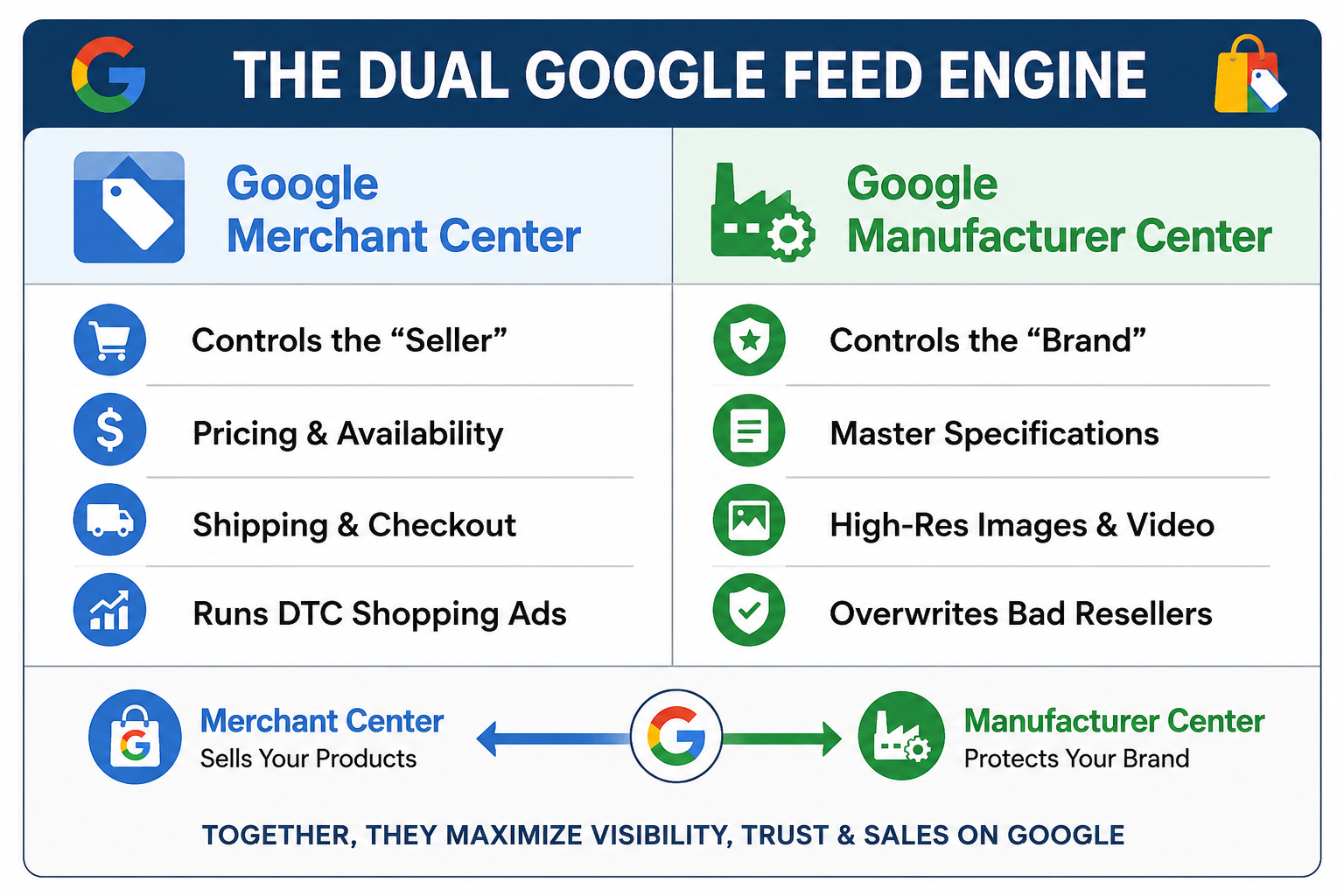
Why does this matter to a $5M–$25M manufacturer? When your wholesale dealers, distributors, or third-party retailers upload incomplete GTINs, low-resolution images, or incorrect technical specifications to Google, it degrades your brand image and harms ad performance across the web.
By claiming and enriching your product catalog in Google Manufacturer Center, you provide Google with master product data. Google then uses your authoritative specifications to overwrite messy third-party reseller listings, enrich organic search results, and improve Google Shopping ad quality scores for both your direct storefront and your authorized dealer network.
## The 60-Day Pre-Freeze Sprint
To enter Q4 with total operational confidence, your team needs to execute a dedicated 60-day cleanup sprint before your IT or web development team freezes site changes in October.
To enter Q4 with total operational confidence, your team needs to execute a dedicated 60-day cleanup sprint before your IT or web development team freezes site changes in October.
### 1. Catalog & GTIN Audit
Silent disapprovals in Google Merchant Center are revenue killers. Audit your catalog for missing GTINs, incorrect MPNs, and broken variant mappings (color, size, fitment). Fixing feed errors in August ensures your entire catalog is indexed and eligible for maximum impression share before bid costs increase in November.
### 2. Claim & Enrich Google Manufacturer Center Data
Upload high-resolution hero imagery, detailed product titles, technical spec sheets, and feature bullets directly into Google Manufacturer Center. Map these master feeds to your primary brand GTINs so Google recognizes your company as the authoritative source of truth.
### 3. GA4 & Attribution Tracking Runway
You cannot optimize what you do not measure accurately. Use the pre-freeze window to audit your [Google Analytics 4 (GA4) configuration](https://dabrianmarketing.com/digital-analytics/). Ensure server-side event tracking and conversion rules cleanly separate direct ecommerce purchases from wholesale dealer locator inquiries. When holiday ad spend increases, leadership needs absolute clarity on DTC sales revenue versus B2B lead generation.
4\. Custom Labeling & Margin-Based Asset Groups
Stop dumping ad spend into broad, unstructured Performance Max campaigns that waste budget on low-margin products. Implement custom feed labels in your product data to segment inventory by margin tier, stock levels, or product type. This allows your ad managers to aggressively push high-margin Fall Sports gear, Auto accessories, or Pet products while suppressing low-margin or low-stock SKUs.
## September Transition: AI Search Visibility & 2027 Budgeting
Once feed cleanups and tracking setups are completed in August, September shifts the focus to long-term market positioning and fiscal planning.
### **Preparing for Answer Engine Optimization (AEO)**
Modern buyers are increasingly using [AI answer engines](https://blog.dabrianmarketing.com/the-rise-of-the-ai-cited-brand-merging-seo-and-aeo-in-2026) such as ChatGPT, Perplexity, and Google AI Overviews to research technical product specifications before making purchasing decisions. AI engines rely heavily on structured schema markup and authoritative brand feeds like Google Manufacturer Center. When your product data is clean, structured, and standardized, AI engines are significantly more likely to cite your brand directly when shoppers ask technical questions like *"What are the best heavy-duty automotive winches for off-road use?"* or *"Which pet travel crates meet airline cargo standards?"*
[51% of B2B buyers now begin research in an AI chatbot — up from 29% in April 2025, a 22-point jump in 12 months - (G2, March 2026)](https://www.omnibound.ai/blog/answer-engine-optimization-aeo-statistics)
### **Managing Channel Conflict**
A common fear among hybrid manufacturers is that aggressive online marketing will alienate wholesale dealers. The solution lies in smart channel segmentation. Use Google Shopping ads to drive high-margin DTC sales for specialized accessories and direct-replacement parts, while simultaneously leveraging [localized search campaigns](https://dabrianmarketing.com/digital-marketing/ppc-advertising/) and structured dealer locators to drive local foot traffic directly into your retail partners' physical stores.
### **Planning the 2027 Digital Infrastructure Budget**
Late Q3 is when forward-thinking leadership teams evaluate what broke in their digital infrastructure over the past year and assign a budget for the coming fiscal year.
While your Q4 execution engine runs on autopilot, use September to scope out long-term infrastructure investments for 2027, such as:
- Upgrading to custom B2B wholesale ordering portals.
- Overhauling technical product SEO foundations.
- Integrating CRM platforms like HubSpot with your internal ERP to bridge marketing leads with dealer sales pipelines.
## Taking Action Without Burning Out Your Team
The biggest challenge for most mid-market hybrid manufacturers isn't a lack of vision. It's bandwidth! Small internal teams are already balancing fulfillment, customer service, and daily campaign management. Expecting them to audit thousands of technical SKUs, configure new feed portals, and overhaul attribution setups in 60 days is often unrealistic.
Bringing in fractional execution support during the July–September setup phase gives your internal team the expert firepower needed to clean up product feeds and lock in accurate tracking before October code freezes. You get clean data, brand control across Google, and clear attribution without burning out your internal staff before the peak selling season even starts.
If you want to ensure your product catalog is accurate, optimized, and ready for Q4, let's look at your current feed health and build a pre-freeze action plan today.
- [Share](http://www.facebook.com/sharer/sharer.php?u=https://blog.dabrianmarketing.com/fix-product-feeds-tracking-before-october-code-freezes)
- [Tweet](https://twitter.com/intent/tweet?url=https://blog.dabrianmarketing.com/fix-product-feeds-tracking-before-october-code-freezes&text=How%20Hybrid%20Manufacturers%20Take%20Control%20of%20Google%20Product%20Data%20Before%20Q4)
- [Share](http://www.linkedin.com/shareArticle?mini=true&url=https://blog.dabrianmarketing.com/fix-product-feeds-tracking-before-october-code-freezes)
 [Ecommerce Strategy](https://blog.dabrianmarketing.com/tag/ecommerce-strategy), [Google Manufacturer Center](https://blog.dabrianmarketing.com/tag/google-manufacturer-center), [Hybrid Manufacturing](https://blog.dabrianmarketing.com/tag/hybrid-manufacturing), [Feed Optimization](https://blog.dabrianmarketing.com/tag/feed-optimization)
### Subscribe to our Blog
### Recent Posts
### Categories
- [Marketing Strategy (126)](https://blog.dabrianmarketing.com/tag/marketing-strategy)
- [web design (83)](https://blog.dabrianmarketing.com/tag/web-design)
- [digital marketing (73)](https://blog.dabrianmarketing.com/tag/digital-marketing)
- [Search Engine Optimization (SEO) (62)](https://blog.dabrianmarketing.com/tag/search-engine-optimization-seo)
- [Paid Search (PPC) (59)](https://blog.dabrianmarketing.com/tag/paid-search-ppc)
- [Digital Analytics (55)](https://blog.dabrianmarketing.com/tag/digital-analytics)
- [seo (51)](https://blog.dabrianmarketing.com/tag/seo)
- [Google Analytics (50)](https://blog.dabrianmarketing.com/tag/google-analytics)
- [News & Events (48)](https://blog.dabrianmarketing.com/tag/news-events)
- [Social Media Marketing & Management (47)](https://blog.dabrianmarketing.com/tag/social-media-marketing-management)
- [Content Marketing (45)](https://blog.dabrianmarketing.com/tag/content-marketing)
- [PPC (43)](https://blog.dabrianmarketing.com/tag/ppc)
- [Ecommerce & Retail Marketing (39)](https://blog.dabrianmarketing.com/tag/ecommerce-retail-marketing)
- [Business to Business Marketing (34)](https://blog.dabrianmarketing.com/tag/business-to-business-marketing)
- [Website design (34)](https://blog.dabrianmarketing.com/tag/website-design)
- [Mobile marketing (33)](https://blog.dabrianmarketing.com/tag/mobile-marketing)
- [local seo (32)](https://blog.dabrianmarketing.com/tag/local-seo)
- [eCommerce (31)](https://blog.dabrianmarketing.com/tag/ecommerce)
- [Inbound marketing (29)](https://blog.dabrianmarketing.com/tag/inbound-marketing)
- [B2B marketing (27)](https://blog.dabrianmarketing.com/tag/b2b-marketing)
- [social media (26)](https://blog.dabrianmarketing.com/tag/social-media)
- [email marketing (25)](https://blog.dabrianmarketing.com/tag/email-marketing)
- [social media marketing (25)](https://blog.dabrianmarketing.com/tag/social-media-marketing)
- [website redesign (25)](https://blog.dabrianmarketing.com/tag/website-redesign)
- [B2B (24)](https://blog.dabrianmarketing.com/tag/b2b)
- [Financial Services (23)](https://blog.dabrianmarketing.com/tag/financial-services)
- [website development (23)](https://blog.dabrianmarketing.com/tag/website-development)
- [Pay Per Click (20)](https://blog.dabrianmarketing.com/tag/pay-per-click)
- [SEO strategy (20)](https://blog.dabrianmarketing.com/tag/seo-strategy)
- [B2B marketing agency (19)](https://blog.dabrianmarketing.com/tag/b2b-marketing-agency)
- [marketing (19)](https://blog.dabrianmarketing.com/tag/marketing)
- [web development (19)](https://blog.dabrianmarketing.com/tag/web-development)
- [Google AdWords (17)](https://blog.dabrianmarketing.com/tag/google-adwords)
- [marketing automation (17)](https://blog.dabrianmarketing.com/tag/marketing-automation)
- [press release (16)](https://blog.dabrianmarketing.com/tag/press-release)
- [Social Media Management (15)](https://blog.dabrianmarketing.com/tag/social-media-management)
- [ecommerce marketing (15)](https://blog.dabrianmarketing.com/tag/ecommerce-marketing)
- [lead generation (15)](https://blog.dabrianmarketing.com/tag/lead-generation)
- [social media strategy (15)](https://blog.dabrianmarketing.com/tag/social-media-strategy)
- [Web Design Strategy/Website Strategy (14)](https://blog.dabrianmarketing.com/tag/web-design-strategy-website-strategy)
- [content (14)](https://blog.dabrianmarketing.com/tag/content)
- [web design services for small business (14)](https://blog.dabrianmarketing.com/tag/web-design-services-for-small-business)
- [Web Design Trends (13)](https://blog.dabrianmarketing.com/tag/web-design-trends)
- [financial services marketing (13)](https://blog.dabrianmarketing.com/tag/financial-services-marketing)
- [sales (13)](https://blog.dabrianmarketing.com/tag/sales)
- [Digital Branding (12)](https://blog.dabrianmarketing.com/tag/digital-branding)
- [Healthcare & Wellness (12)](https://blog.dabrianmarketing.com/tag/healthcare-wellness)
- [Social Strategy (12)](https://blog.dabrianmarketing.com/tag/social-strategy)
- [Video Marketing (12)](https://blog.dabrianmarketing.com/tag/video-marketing)
- [branding (12)](https://blog.dabrianmarketing.com/tag/branding)
- [search engine optimization (12)](https://blog.dabrianmarketing.com/tag/search-engine-optimization)
- [Analytics (11)](https://blog.dabrianmarketing.com/tag/analytics)
- [Artificial intelligence (AI) (11)](https://blog.dabrianmarketing.com/tag/artificial-intelligence-ai)
- [Retail Marketing (11)](https://blog.dabrianmarketing.com/tag/retail-marketing)
- [SEM (11)](https://blog.dabrianmarketing.com/tag/sem)
- [digital advertising (11)](https://blog.dabrianmarketing.com/tag/digital-advertising)
- [increase brand awareness (11)](https://blog.dabrianmarketing.com/tag/increase-brand-awareness)
- [internet marketing (11)](https://blog.dabrianmarketing.com/tag/internet-marketing)
- [online shopping (11)](https://blog.dabrianmarketing.com/tag/online-shopping)
- [responsive web design (11)](https://blog.dabrianmarketing.com/tag/responsive-web-design)
- [web analytics (11)](https://blog.dabrianmarketing.com/tag/web-analytics)
- [Healthcare Marketing (10)](https://blog.dabrianmarketing.com/tag/healthcare-marketing)
- [Home Services (10)](https://blog.dabrianmarketing.com/tag/home-services)
- [Lead Generation Marketing (10)](https://blog.dabrianmarketing.com/tag/lead-generation-marketing)
- [SEO Services (10)](https://blog.dabrianmarketing.com/tag/seo-services)
- [financial advisors marketing (10)](https://blog.dabrianmarketing.com/tag/financial-advisors-marketing)
- [local listing management (10)](https://blog.dabrianmarketing.com/tag/local-listing-management)
- [Bank Marketing (9)](https://blog.dabrianmarketing.com/tag/bank-marketing)
- [CRM (9)](https://blog.dabrianmarketing.com/tag/crm)
- [Content Planning (9)](https://blog.dabrianmarketing.com/tag/content-planning)
- [Google Ads (9)](https://blog.dabrianmarketing.com/tag/google-ads)
- [Inbound Marketing Strategies (9)](https://blog.dabrianmarketing.com/tag/inbound-marketing-strategies)
- [PPC Marketing (9)](https://blog.dabrianmarketing.com/tag/ppc-marketing)
- [WordPress (9)](https://blog.dabrianmarketing.com/tag/wordpress)
- [content development (9)](https://blog.dabrianmarketing.com/tag/content-development)
- [content strategy (9)](https://blog.dabrianmarketing.com/tag/content-strategy)
- [redesign website (9)](https://blog.dabrianmarketing.com/tag/redesign-website)
- [web designer (9)](https://blog.dabrianmarketing.com/tag/web-designer)
- [2024 Planning (8)](https://blog.dabrianmarketing.com/tag/2024-planning)
- [B2C Marketing (8)](https://blog.dabrianmarketing.com/tag/b2c-marketing)
- [Retail Sales (8)](https://blog.dabrianmarketing.com/tag/retail-sales)
- [Shopify (8)](https://blog.dabrianmarketing.com/tag/shopify)
- [Social Media Metrics (8)](https://blog.dabrianmarketing.com/tag/social-media-metrics)
- [Web Security (8)](https://blog.dabrianmarketing.com/tag/web-security)
- [b2b sales (8)](https://blog.dabrianmarketing.com/tag/b2b-sales)
- [financial marketing (8)](https://blog.dabrianmarketing.com/tag/financial-marketing)
- [project management (8)](https://blog.dabrianmarketing.com/tag/project-management)
- [social marketing (8)](https://blog.dabrianmarketing.com/tag/social-marketing)
- [social media analytics (8)](https://blog.dabrianmarketing.com/tag/social-media-analytics)
- [strategic marketing (8)](https://blog.dabrianmarketing.com/tag/strategic-marketing)
- [website (8)](https://blog.dabrianmarketing.com/tag/website)
- [2025 Planning (7)](https://blog.dabrianmarketing.com/tag/2025-planning)
- [AdWords (7)](https://blog.dabrianmarketing.com/tag/adwords)
- [Bing Ads (7)](https://blog.dabrianmarketing.com/tag/bing-ads)
- [Mobile design (7)](https://blog.dabrianmarketing.com/tag/mobile-design)
- [ROI (7)](https://blog.dabrianmarketing.com/tag/roi)
- [Sales Strategy (7)](https://blog.dabrianmarketing.com/tag/sales-strategy)
- [brand identity (7)](https://blog.dabrianmarketing.com/tag/brand-identity)
- [business strategy (7)](https://blog.dabrianmarketing.com/tag/business-strategy)
- [content optimization (7)](https://blog.dabrianmarketing.com/tag/content-optimization)
- [home services marketing (7)](https://blog.dabrianmarketing.com/tag/home-services-marketing)
- [link building (7)](https://blog.dabrianmarketing.com/tag/link-building)
- [mobile (7)](https://blog.dabrianmarketing.com/tag/mobile)
- [mobile website (7)](https://blog.dabrianmarketing.com/tag/mobile-website)
- [ppc advertising (7)](https://blog.dabrianmarketing.com/tag/ppc-advertising)
- [social tips (7)](https://blog.dabrianmarketing.com/tag/social-tips)
- [AI Content (6)](https://blog.dabrianmarketing.com/tag/ai-content)
- [CMS (6)](https://blog.dabrianmarketing.com/tag/cms)
- [Customer Persona (6)](https://blog.dabrianmarketing.com/tag/customer-persona)
- [Link Earning (6)](https://blog.dabrianmarketing.com/tag/link-earning)
- [Online Sales (6)](https://blog.dabrianmarketing.com/tag/online-sales)
- [SEO Agency (6)](https://blog.dabrianmarketing.com/tag/seo-agency)
- [SEO measurement (6)](https://blog.dabrianmarketing.com/tag/seo-measurement)
- [Search Engine Marketing (6)](https://blog.dabrianmarketing.com/tag/search-engine-marketing)
- [account-based marketing (6)](https://blog.dabrianmarketing.com/tag/account-based-marketing)
- [brand development (6)](https://blog.dabrianmarketing.com/tag/brand-development)
- [digital marketing agency (6)](https://blog.dabrianmarketing.com/tag/digital-marketing-agency)
- [digital marketing strategy (6)](https://blog.dabrianmarketing.com/tag/digital-marketing-strategy)
- [hubspot cms (6)](https://blog.dabrianmarketing.com/tag/hubspot-cms)
- [keyword research (6)](https://blog.dabrianmarketing.com/tag/keyword-research)
- [measurement (6)](https://blog.dabrianmarketing.com/tag/measurement)
- [news and events (6)](https://blog.dabrianmarketing.com/tag/news-and-events)
- [shopify website (6)](https://blog.dabrianmarketing.com/tag/shopify-website)
- [shopping ads (6)](https://blog.dabrianmarketing.com/tag/shopping-ads)
- [small business (6)](https://blog.dabrianmarketing.com/tag/small-business)
- [social analytics (6)](https://blog.dabrianmarketing.com/tag/social-analytics)
- [strategy (6)](https://blog.dabrianmarketing.com/tag/strategy)
- [Paid Search (5)](https://blog.dabrianmarketing.com/tag/paid-search)
- [Plumbing Marketing (5)](https://blog.dabrianmarketing.com/tag/plumbing-marketing)
- [brand guidelines (5)](https://blog.dabrianmarketing.com/tag/brand-guidelines)
- [business to business (5)](https://blog.dabrianmarketing.com/tag/business-to-business)
- [customer relationship management (5)](https://blog.dabrianmarketing.com/tag/customer-relationship-management)
- [customer relationship management tools (5)](https://blog.dabrianmarketing.com/tag/customer-relationship-management-tools)
- [google shopping (5)](https://blog.dabrianmarketing.com/tag/google-shopping)
- [hubspot agency (5)](https://blog.dabrianmarketing.com/tag/hubspot-agency)
- [inbound marketing strategy (5)](https://blog.dabrianmarketing.com/tag/inbound-marketing-strategy)
- [lead generation website (5)](https://blog.dabrianmarketing.com/tag/lead-generation-website)
- [marketing insights (5)](https://blog.dabrianmarketing.com/tag/marketing-insights)
- [marketing tips (5)](https://blog.dabrianmarketing.com/tag/marketing-tips)
- [measuring SEO (5)](https://blog.dabrianmarketing.com/tag/measuring-seo)
- [paid search campaigns (5)](https://blog.dabrianmarketing.com/tag/paid-search-campaigns)
- [ppc management (5)](https://blog.dabrianmarketing.com/tag/ppc-management)
- [sales CRM (5)](https://blog.dabrianmarketing.com/tag/sales-crm)
- [user experience (5)](https://blog.dabrianmarketing.com/tag/user-experience)
- [video (5)](https://blog.dabrianmarketing.com/tag/video)
- [web developer (5)](https://blog.dabrianmarketing.com/tag/web-developer)
- [2026 planning (4)](https://blog.dabrianmarketing.com/tag/2026-planning)
- [Artificial Intelligence (4)](https://blog.dabrianmarketing.com/tag/artificial-intelligence)
- [CMS Hub (4)](https://blog.dabrianmarketing.com/tag/cms-hub)
- [Call Tracking (4)](https://blog.dabrianmarketing.com/tag/call-tracking)
- [Facebook (4)](https://blog.dabrianmarketing.com/tag/facebook)
- [Improve productivity (4)](https://blog.dabrianmarketing.com/tag/improve-productivity)
- [Inbound Sales Strategy (4)](https://blog.dabrianmarketing.com/tag/inbound-sales-strategy)
- [Insurance Marketing (4)](https://blog.dabrianmarketing.com/tag/insurance-marketing)
- [KPIs (4)](https://blog.dabrianmarketing.com/tag/kpis)
- [Local Listings (4)](https://blog.dabrianmarketing.com/tag/local-listings)
- [Logo Design (4)](https://blog.dabrianmarketing.com/tag/logo-design)
- [Non-Profit Marketing (4)](https://blog.dabrianmarketing.com/tag/non-profit-marketing)
- [Organic Search (4)](https://blog.dabrianmarketing.com/tag/organic-search)
- [Outbound Sales Strategy (4)](https://blog.dabrianmarketing.com/tag/outbound-sales-strategy)
- [SERPS (4)](https://blog.dabrianmarketing.com/tag/serps)
- [Social media updates (4)](https://blog.dabrianmarketing.com/tag/social-media-updates)
- [Uncategorized (4)](https://blog.dabrianmarketing.com/tag/uncategorized)
- [Wealth Management marketing (4)](https://blog.dabrianmarketing.com/tag/wealth-management-marketing)
- [aeo (4)](https://blog.dabrianmarketing.com/tag/aeo)
- [compliance (4)](https://blog.dabrianmarketing.com/tag/compliance)
- [conversions (4)](https://blog.dabrianmarketing.com/tag/conversions)
- [creative design (4)](https://blog.dabrianmarketing.com/tag/creative-design)
- [credit union (4)](https://blog.dabrianmarketing.com/tag/credit-union)
- [customer relationship system (4)](https://blog.dabrianmarketing.com/tag/customer-relationship-system)
- [dabrian marketing (4)](https://blog.dabrianmarketing.com/tag/dabrian-marketing)
- [data (4)](https://blog.dabrianmarketing.com/tag/data)
- [ecommerce SEO (4)](https://blog.dabrianmarketing.com/tag/ecommerce-seo)
- [email (4)](https://blog.dabrianmarketing.com/tag/email)
- [home improvement (4)](https://blog.dabrianmarketing.com/tag/home-improvement)
- [leads (4)](https://blog.dabrianmarketing.com/tag/leads)
- [local search (4)](https://blog.dabrianmarketing.com/tag/local-search)
- [manufacturing marketing (4)](https://blog.dabrianmarketing.com/tag/manufacturing-marketing)
- [mobile advertising (4)](https://blog.dabrianmarketing.com/tag/mobile-advertising)
- [news (4)](https://blog.dabrianmarketing.com/tag/news)
- [optimization (4)](https://blog.dabrianmarketing.com/tag/optimization)
- [paid online advertising (4)](https://blog.dabrianmarketing.com/tag/paid-online-advertising)
- [sales funnel (4)](https://blog.dabrianmarketing.com/tag/sales-funnel)
- [sales pipeline (4)](https://blog.dabrianmarketing.com/tag/sales-pipeline)
- [security (4)](https://blog.dabrianmarketing.com/tag/security)
- [smart goals (4)](https://blog.dabrianmarketing.com/tag/smart-goals)
- [social advertising (4)](https://blog.dabrianmarketing.com/tag/social-advertising)
- [social media tips (4)](https://blog.dabrianmarketing.com/tag/social-media-tips)
- [tag management (4)](https://blog.dabrianmarketing.com/tag/tag-management)
- [trends (4)](https://blog.dabrianmarketing.com/tag/trends)
- [2023 (3)](https://blog.dabrianmarketing.com/tag/2023)
- [AI SEO (3)](https://blog.dabrianmarketing.com/tag/ai-seo)
- [Adobe Analytics (3)](https://blog.dabrianmarketing.com/tag/adobe-analytics)
- [Amazon Advertising (3)](https://blog.dabrianmarketing.com/tag/amazon-advertising)
- [Automotive Marketing (3)](https://blog.dabrianmarketing.com/tag/automotive-marketing)
- [B2B Content (3)](https://blog.dabrianmarketing.com/tag/b2b-content)
- [B2B Search Marketing (3)](https://blog.dabrianmarketing.com/tag/b2b-search-marketing)
- [B2B eCommerce (3)](https://blog.dabrianmarketing.com/tag/b2b-ecommerce)
- [B2C (3)](https://blog.dabrianmarketing.com/tag/b2c)
- [Continuous Website Improvement (3)](https://blog.dabrianmarketing.com/tag/continuous-website-improvement)
- [Google My Business (3)](https://blog.dabrianmarketing.com/tag/google-my-business)
- [Growth Driven Design (3)](https://blog.dabrianmarketing.com/tag/growth-driven-design)
- [HVAC (3)](https://blog.dabrianmarketing.com/tag/hvac)
- [Home Improvement Marketing (3)](https://blog.dabrianmarketing.com/tag/home-improvement-marketing)
- [Hospital Marketing (3)](https://blog.dabrianmarketing.com/tag/hospital-marketing)
- [Lawn Care Marketing (3)](https://blog.dabrianmarketing.com/tag/lawn-care-marketing)
- [LinkedIn (3)](https://blog.dabrianmarketing.com/tag/linkedin)
- [Marketing Budgeting (3)](https://blog.dabrianmarketing.com/tag/marketing-budgeting)
- [Measurement Planning (3)](https://blog.dabrianmarketing.com/tag/measurement-planning)
- [Multivariate Testing (3)](https://blog.dabrianmarketing.com/tag/multivariate-testing)
- [Online Business (3)](https://blog.dabrianmarketing.com/tag/online-business)
- [Partnership (3)](https://blog.dabrianmarketing.com/tag/partnership)
- [Personas (3)](https://blog.dabrianmarketing.com/tag/personas)
- [Product Inventory (3)](https://blog.dabrianmarketing.com/tag/product-inventory)
- [SEO Reporting (3)](https://blog.dabrianmarketing.com/tag/seo-reporting)
- [SOCIAL ECOMMERCE (3)](https://blog.dabrianmarketing.com/tag/social-ecommerce)
- [Sales Prospecting (3)](https://blog.dabrianmarketing.com/tag/sales-prospecting)
- [Sales and Marketing Alignment (3)](https://blog.dabrianmarketing.com/tag/sales-and-marketing-alignment)
- [Speed-to-Lead (3)](https://blog.dabrianmarketing.com/tag/speed-to-lead)
- [Time Management (3)](https://blog.dabrianmarketing.com/tag/time-management)
- [Twitter (3)](https://blog.dabrianmarketing.com/tag/twitter)
- [UX Design (3)](https://blog.dabrianmarketing.com/tag/ux-design)
- [UX research (3)](https://blog.dabrianmarketing.com/tag/ux-research)
- [adCenter (3)](https://blog.dabrianmarketing.com/tag/adcenter)
- [advertising (3)](https://blog.dabrianmarketing.com/tag/advertising)
- [api (3)](https://blog.dabrianmarketing.com/tag/api)
- [attribution modeling (3)](https://blog.dabrianmarketing.com/tag/attribution-modeling)
- [bank advertising (3)](https://blog.dabrianmarketing.com/tag/bank-advertising)
- [big data (3)](https://blog.dabrianmarketing.com/tag/big-data)
- [construction marketing (3)](https://blog.dabrianmarketing.com/tag/construction-marketing)
- [consumer services (3)](https://blog.dabrianmarketing.com/tag/consumer-services)
- [customer (3)](https://blog.dabrianmarketing.com/tag/customer)
- [data privacy (3)](https://blog.dabrianmarketing.com/tag/data-privacy)
- [digital content (3)](https://blog.dabrianmarketing.com/tag/digital-content)
- [digital marketing measurement (3)](https://blog.dabrianmarketing.com/tag/digital-marketing-measurement)
- [digital marketing services (3)](https://blog.dabrianmarketing.com/tag/digital-marketing-services)
- [email for ecommerce (3)](https://blog.dabrianmarketing.com/tag/email-for-ecommerce)
- [facebook ads (3)](https://blog.dabrianmarketing.com/tag/facebook-ads)
- [google partners connect (3)](https://blog.dabrianmarketing.com/tag/google-partners-connect)
- [graphic design (3)](https://blog.dabrianmarketing.com/tag/graphic-design)
- [hubspot (3)](https://blog.dabrianmarketing.com/tag/hubspot)
- [hubspot crm (3)](https://blog.dabrianmarketing.com/tag/hubspot-crm)
- [hubspot sales (3)](https://blog.dabrianmarketing.com/tag/hubspot-sales)
- [instagram (3)](https://blog.dabrianmarketing.com/tag/instagram)
- [marketing metrics (3)](https://blog.dabrianmarketing.com/tag/marketing-metrics)
- [minority owned businesses (3)](https://blog.dabrianmarketing.com/tag/minority-owned-businesses)
- [monitor (3)](https://blog.dabrianmarketing.com/tag/monitor)
- [omnichannel Marketing (3)](https://blog.dabrianmarketing.com/tag/omnichannel-marketing)
- [on-page seo (3)](https://blog.dabrianmarketing.com/tag/on-page-seo)
- [online reputation management (3)](https://blog.dabrianmarketing.com/tag/online-reputation-management)
- [online store (3)](https://blog.dabrianmarketing.com/tag/online-store)
- [paid search advertising (3)](https://blog.dabrianmarketing.com/tag/paid-search-advertising)
- [pay per click advertising campaigns (3)](https://blog.dabrianmarketing.com/tag/pay-per-click-advertising-campaigns)
- [plumbing (3)](https://blog.dabrianmarketing.com/tag/plumbing)
- [ppc account management (3)](https://blog.dabrianmarketing.com/tag/ppc-account-management)
- [reputation management (3)](https://blog.dabrianmarketing.com/tag/reputation-management)
- [sales enablement (3)](https://blog.dabrianmarketing.com/tag/sales-enablement)
- [tips (3)](https://blog.dabrianmarketing.com/tag/tips)
- [voice search (3)](https://blog.dabrianmarketing.com/tag/voice-search)
- [#agencylife (2)](https://blog.dabrianmarketing.com/tag/agencylife)
- [2022 (2)](https://blog.dabrianmarketing.com/tag/2022)
- [2023 planning (2)](https://blog.dabrianmarketing.com/tag/2023-planning)
- [2024 (2)](https://blog.dabrianmarketing.com/tag/2024)
- [ABM (2)](https://blog.dabrianmarketing.com/tag/abm)
- [B2B growth (2)](https://blog.dabrianmarketing.com/tag/b2b-growth)
- [BigCommerce (2)](https://blog.dabrianmarketing.com/tag/bigcommerce)
- [Business growth opportunities (2)](https://blog.dabrianmarketing.com/tag/business-growth-opportunities)
- [COVID (2)](https://blog.dabrianmarketing.com/tag/covid)
- [CRM alignment (2)](https://blog.dabrianmarketing.com/tag/crm-alignment)
- [Conversion Tracking (2)](https://blog.dabrianmarketing.com/tag/conversion-tracking)
- [Covid-19 (2)](https://blog.dabrianmarketing.com/tag/covid-19)
- [Facebook Tips (2)](https://blog.dabrianmarketing.com/tag/facebook-tips)
- [Facebook business (2)](https://blog.dabrianmarketing.com/tag/facebook-business)
- [GDPR (2)](https://blog.dabrianmarketing.com/tag/gdpr)
- [Gmail tips (2)](https://blog.dabrianmarketing.com/tag/gmail-tips)
- [Google Business Profile (2)](https://blog.dabrianmarketing.com/tag/google-business-profile)
- [Google event (2)](https://blog.dabrianmarketing.com/tag/google-event)
- [Home Improvement Trends (2)](https://blog.dabrianmarketing.com/tag/home-improvement-trends)
- [LinkedIn Ads (2)](https://blog.dabrianmarketing.com/tag/linkedin-ads)
- [Local SEO Strategy (2)](https://blog.dabrianmarketing.com/tag/local-seo-strategy)
- [Logistics (2)](https://blog.dabrianmarketing.com/tag/logistics)
- [Minority Business Enterprise (2)](https://blog.dabrianmarketing.com/tag/minority-business-enterprise)
- [Online Advertising (2)](https://blog.dabrianmarketing.com/tag/online-advertising)
- [Product Data Feed (2)](https://blog.dabrianmarketing.com/tag/product-data-feed)
- [Qualitative Data (2)](https://blog.dabrianmarketing.com/tag/qualitative-data)
- [Restaurant Marketing (2)](https://blog.dabrianmarketing.com/tag/restaurant-marketing)
- [SBE (2)](https://blog.dabrianmarketing.com/tag/sbe)
- [Twitter Tips (2)](https://blog.dabrianmarketing.com/tag/twitter-tips)
- [UX (2)](https://blog.dabrianmarketing.com/tag/ux)
- [Video SEO (2)](https://blog.dabrianmarketing.com/tag/video-seo)
- [Yelp (2)](https://blog.dabrianmarketing.com/tag/yelp)
- [ad copy (2)](https://blog.dabrianmarketing.com/tag/ad-copy)
- [agency transparency (2)](https://blog.dabrianmarketing.com/tag/agency-transparency)
- [algorithm management (2)](https://blog.dabrianmarketing.com/tag/algorithm-management)
- [automated bidding (2)](https://blog.dabrianmarketing.com/tag/automated-bidding)
- [budget (2)](https://blog.dabrianmarketing.com/tag/budget)
- [business growth (2)](https://blog.dabrianmarketing.com/tag/business-growth)
- [certification (2)](https://blog.dabrianmarketing.com/tag/certification)
- [client appreciation (2)](https://blog.dabrianmarketing.com/tag/client-appreciation)
- [clients (2)](https://blog.dabrianmarketing.com/tag/clients)
- [cloud (2)](https://blog.dabrianmarketing.com/tag/cloud)
- [communication (2)](https://blog.dabrianmarketing.com/tag/communication)
- [content promotion (2)](https://blog.dabrianmarketing.com/tag/content-promotion)
- [copywriting (2)](https://blog.dabrianmarketing.com/tag/copywriting)
- [data driven culture (2)](https://blog.dabrianmarketing.com/tag/data-driven-culture)
- [data driven marketing (2)](https://blog.dabrianmarketing.com/tag/data-driven-marketing)
- [data mining (2)](https://blog.dabrianmarketing.com/tag/data-mining)
- [design (2)](https://blog.dabrianmarketing.com/tag/design)
- [digital avertising (2)](https://blog.dabrianmarketing.com/tag/digital-avertising)
- [digital transformation (2)](https://blog.dabrianmarketing.com/tag/digital-transformation)
- [digital vs traditional (2)](https://blog.dabrianmarketing.com/tag/digital-vs-traditional)
- [education (2)](https://blog.dabrianmarketing.com/tag/education)
- [email analytics (2)](https://blog.dabrianmarketing.com/tag/email-analytics)
- [email marketing measurement (2)](https://blog.dabrianmarketing.com/tag/email-marketing-measurement)
- [enhanced campaigns (2)](https://blog.dabrianmarketing.com/tag/enhanced-campaigns)
- [guide (2)](https://blog.dabrianmarketing.com/tag/guide)
- [healthcare marketing agency (2)](https://blog.dabrianmarketing.com/tag/healthcare-marketing-agency)
- [hootsuite (2)](https://blog.dabrianmarketing.com/tag/hootsuite)
- [hosting services (2)](https://blog.dabrianmarketing.com/tag/hosting-services)
- [implementing (2)](https://blog.dabrianmarketing.com/tag/implementing)
- [inbound leads (2)](https://blog.dabrianmarketing.com/tag/inbound-leads)
- [inbound success plan (2)](https://blog.dabrianmarketing.com/tag/inbound-success-plan)
- [industries (2)](https://blog.dabrianmarketing.com/tag/industries)
- [industry solutions (2)](https://blog.dabrianmarketing.com/tag/industry-solutions)
- [insurance and trust (2)](https://blog.dabrianmarketing.com/tag/insurance-and-trust)
- [interactive content (2)](https://blog.dabrianmarketing.com/tag/interactive-content)
- [internet (2)](https://blog.dabrianmarketing.com/tag/internet)
- [landing (2)](https://blog.dabrianmarketing.com/tag/landing)
- [landing page (2)](https://blog.dabrianmarketing.com/tag/landing-page)
- [lead generation tools (2)](https://blog.dabrianmarketing.com/tag/lead-generation-tools)
- [lehigh valley (2)](https://blog.dabrianmarketing.com/tag/lehigh-valley)
- [local business (2)](https://blog.dabrianmarketing.com/tag/local-business)
- [local event (2)](https://blog.dabrianmarketing.com/tag/local-event)
- [local listing (2)](https://blog.dabrianmarketing.com/tag/local-listing)
- [logo types (2)](https://blog.dabrianmarketing.com/tag/logo-types)
- [marketing tools (2)](https://blog.dabrianmarketing.com/tag/marketing-tools)
- [measure (2)](https://blog.dabrianmarketing.com/tag/measure)
- [medical marketing (2)](https://blog.dabrianmarketing.com/tag/medical-marketing)
- [mobile analytics (2)](https://blog.dabrianmarketing.com/tag/mobile-analytics)
- [mobile app (2)](https://blog.dabrianmarketing.com/tag/mobile-app)
- [mobile optimization (2)](https://blog.dabrianmarketing.com/tag/mobile-optimization)
- [mobile seo (2)](https://blog.dabrianmarketing.com/tag/mobile-seo)
- [multichannel (2)](https://blog.dabrianmarketing.com/tag/multichannel)
- [multichannel marketing (2)](https://blog.dabrianmarketing.com/tag/multichannel-marketing)
- [native ads (2)](https://blog.dabrianmarketing.com/tag/native-ads)
- [news release (2)](https://blog.dabrianmarketing.com/tag/news-release)
- [non-profit (2)](https://blog.dabrianmarketing.com/tag/non-profit)
- [nonprofit marketing (2)](https://blog.dabrianmarketing.com/tag/nonprofit-marketing)
- [one page web design (2)](https://blog.dabrianmarketing.com/tag/one-page-web-design)
- [operations process (2)](https://blog.dabrianmarketing.com/tag/operations-process)
- [outbound marketing (2)](https://blog.dabrianmarketing.com/tag/outbound-marketing)
- [phone calls (2)](https://blog.dabrianmarketing.com/tag/phone-calls)
- [platform (2)](https://blog.dabrianmarketing.com/tag/platform)
- [rackspace (2)](https://blog.dabrianmarketing.com/tag/rackspace)
- [reading pa (2)](https://blog.dabrianmarketing.com/tag/reading-pa)
- [remarketing (2)](https://blog.dabrianmarketing.com/tag/remarketing)
- [retargeting (2)](https://blog.dabrianmarketing.com/tag/retargeting)
- [sales plan (2)](https://blog.dabrianmarketing.com/tag/sales-plan)
- [segmentation (2)](https://blog.dabrianmarketing.com/tag/segmentation)
- [self marketing (2)](https://blog.dabrianmarketing.com/tag/self-marketing)
- [social (2)](https://blog.dabrianmarketing.com/tag/social)
- [social commerce (2)](https://blog.dabrianmarketing.com/tag/social-commerce)
- [social media agency (2)](https://blog.dabrianmarketing.com/tag/social-media-agency)
- [staffing and recruitment (2)](https://blog.dabrianmarketing.com/tag/staffing-and-recruitment)
- [successful (2)](https://blog.dabrianmarketing.com/tag/successful)
- [target audience (2)](https://blog.dabrianmarketing.com/tag/target-audience)
- [tariffs (2)](https://blog.dabrianmarketing.com/tag/tariffs)
- [technical seo (2)](https://blog.dabrianmarketing.com/tag/technical-seo)
- [testing (2)](https://blog.dabrianmarketing.com/tag/testing)
- [tracking (2)](https://blog.dabrianmarketing.com/tag/tracking)
- [universal analytics (2)](https://blog.dabrianmarketing.com/tag/universal-analytics)
- [website optimization (2)](https://blog.dabrianmarketing.com/tag/website-optimization)
- [work platforms (2)](https://blog.dabrianmarketing.com/tag/work-platforms)
- [workflows (2)](https://blog.dabrianmarketing.com/tag/workflows)
- [1 page sales plan (1)](https://blog.dabrianmarketing.com/tag/1-page-sales-plan)
- [2021 (1)](https://blog.dabrianmarketing.com/tag/2021)
- [2022 planning (1)](https://blog.dabrianmarketing.com/tag/2022-planning)
- [3pl (1)](https://blog.dabrianmarketing.com/tag/3pl)
- [5 basic principles (1)](https://blog.dabrianmarketing.com/tag/5-basic-principles)
- [AAF (1)](https://blog.dabrianmarketing.com/tag/aaf)
- [AAF-GLV (1)](https://blog.dabrianmarketing.com/tag/aaf-glv)
- [ADA Compliance (1)](https://blog.dabrianmarketing.com/tag/ada-compliance)
- [AI (1)](https://blog.dabrianmarketing.com/tag/ai)
- [Alignment (1)](https://blog.dabrianmarketing.com/tag/alignment)
- [American Advertising Federation (1)](https://blog.dabrianmarketing.com/tag/american-advertising-federation)
- [American Advertising Federation Greater Lehigh Val (1)](https://blog.dabrianmarketing.com/tag/american-advertising-federation-greater-lehigh-val)
- [Answer Engine Optimization (1)](https://blog.dabrianmarketing.com/tag/answer-engine-optimization)
- [AuthorRank (1)](https://blog.dabrianmarketing.com/tag/authorrank)
- [B2B Marketing Strategy (1)](https://blog.dabrianmarketing.com/tag/b2b-marketing-strategy)
- [Backlinks (1)](https://blog.dabrianmarketing.com/tag/backlinks)
- [Bank Lead Generation (1)](https://blog.dabrianmarketing.com/tag/bank-lead-generation)
- [Brightlocal (1)](https://blog.dabrianmarketing.com/tag/brightlocal)
- [Budget Planning (1)](https://blog.dabrianmarketing.com/tag/budget-planning)
- [Business Operations (1)](https://blog.dabrianmarketing.com/tag/business-operations)
- [ChatGPT Marketing (1)](https://blog.dabrianmarketing.com/tag/chatgpt-marketing)
- [Cheap SEO Services (1)](https://blog.dabrianmarketing.com/tag/cheap-seo-services)
- [Cloud U (1)](https://blog.dabrianmarketing.com/tag/cloud-u)
- [Cold Calls (1)](https://blog.dabrianmarketing.com/tag/cold-calls)
- [Cold Email (1)](https://blog.dabrianmarketing.com/tag/cold-email)
- [Cold Outreach (1)](https://blog.dabrianmarketing.com/tag/cold-outreach)
- [Contractor Lead Generation (1)](https://blog.dabrianmarketing.com/tag/contractor-lead-generation)
- [Copywriter (1)](https://blog.dabrianmarketing.com/tag/copywriter)
- [Customer Acquisition (1)](https://blog.dabrianmarketing.com/tag/customer-acquisition)
- [Digital Health Marketing (1)](https://blog.dabrianmarketing.com/tag/digital-health-marketing)
- [Display Advertising (1)](https://blog.dabrianmarketing.com/tag/display-advertising)
- [Dynamic Text (1)](https://blog.dabrianmarketing.com/tag/dynamic-text)
- [Ecommerce Strategy (1)](https://blog.dabrianmarketing.com/tag/ecommerce-strategy)
- [Employee Advocacy (1)](https://blog.dabrianmarketing.com/tag/employee-advocacy)
- [Feed Optimization (1)](https://blog.dabrianmarketing.com/tag/feed-optimization)
- [Financial SEO (1)](https://blog.dabrianmarketing.com/tag/financial-seo)
- [First Party Data (1)](https://blog.dabrianmarketing.com/tag/first-party-data)
- [Fractional Marketing (1)](https://blog.dabrianmarketing.com/tag/fractional-marketing)
- [GK Elite (1)](https://blog.dabrianmarketing.com/tag/gk-elite)
- [General (1)](https://blog.dabrianmarketing.com/tag/general)
- [Generative Engine Optimization (1)](https://blog.dabrianmarketing.com/tag/generative-engine-optimization)
- [Google AI Mode for Healthcare (1)](https://blog.dabrianmarketing.com/tag/google-ai-mode-for-healthcare)
- [Google Ads 2026 (1)](https://blog.dabrianmarketing.com/tag/google-ads-2026)
- [Google Guidelines (1)](https://blog.dabrianmarketing.com/tag/google-guidelines)
- [Google Manufacturer Center (1)](https://blog.dabrianmarketing.com/tag/google-manufacturer-center)
- [Google Marketing Live (1)](https://blog.dabrianmarketing.com/tag/google-marketing-live)
- [Google Rankbrain (1)](https://blog.dabrianmarketing.com/tag/google-rankbrain)
- [Google Rankings (1)](https://blog.dabrianmarketing.com/tag/google-rankings)
- [Google reviews (1)](https://blog.dabrianmarketing.com/tag/google-reviews)
- [Google+ (1)](https://blog.dabrianmarketing.com/tag/google)
- [Growth Strategy (1)](https://blog.dabrianmarketing.com/tag/growth-strategy)
- [HIPAA Compliance (1)](https://blog.dabrianmarketing.com/tag/hipaa-compliance)
- [HIPAA Compliant Marketing (1)](https://blog.dabrianmarketing.com/tag/hipaa-compliant-marketing)
- [HIPPA Compliance (1)](https://blog.dabrianmarketing.com/tag/hippa-compliance)
- [HVAC & Plumbing Strategy (1)](https://blog.dabrianmarketing.com/tag/hvac-plumbing-strategy)
- [Healthcare AI Search (1)](https://blog.dabrianmarketing.com/tag/healthcare-ai-search)
- [Healthcare Advertising (1)](https://blog.dabrianmarketing.com/tag/healthcare-advertising)
- [Healthcare Automation (1)](https://blog.dabrianmarketing.com/tag/healthcare-automation)
- [Healthcare Strategy (1)](https://blog.dabrianmarketing.com/tag/healthcare-strategy)
- [Hospitality & Travel (1)](https://blog.dabrianmarketing.com/tag/hospitality-travel)
- [Hubspot Onboarding (1)](https://blog.dabrianmarketing.com/tag/hubspot-onboarding)
- [Hybrid Manufacturing (1)](https://blog.dabrianmarketing.com/tag/hybrid-manufacturing)
- [Independent Medical Practice (1)](https://blog.dabrianmarketing.com/tag/independent-medical-practice)
- [Independent Medical Practices (1)](https://blog.dabrianmarketing.com/tag/independent-medical-practices)
- [Independent Practice (1)](https://blog.dabrianmarketing.com/tag/independent-practice)
- [Landscaping (1)](https://blog.dabrianmarketing.com/tag/landscaping)
- [Landscaping Marketing (1)](https://blog.dabrianmarketing.com/tag/landscaping-marketing)
- [Legal advice (1)](https://blog.dabrianmarketing.com/tag/legal-advice)
- [Load-Time (1)](https://blog.dabrianmarketing.com/tag/load-time)
- [MBE (1)](https://blog.dabrianmarketing.com/tag/mbe)
- [MWBE (1)](https://blog.dabrianmarketing.com/tag/mwbe)
- [Maintenance Membership (1)](https://blog.dabrianmarketing.com/tag/maintenance-membership)
- [Manufacturing (1)](https://blog.dabrianmarketing.com/tag/manufacturing)
- [Medial PPC (1)](https://blog.dabrianmarketing.com/tag/medial-ppc)
- [Medical Practice Growth (1)](https://blog.dabrianmarketing.com/tag/medical-practice-growth)
- [Medical Practice Marketing (1)](https://blog.dabrianmarketing.com/tag/medical-practice-marketing)
- [Medical Practice SEO (1)](https://blog.dabrianmarketing.com/tag/medical-practice-seo)
- [Microsoft adCenter (1)](https://blog.dabrianmarketing.com/tag/microsoft-adcenter)
- [Millennials (1)](https://blog.dabrianmarketing.com/tag/millennials)
- [ODYSSEY Battery (1)](https://blog.dabrianmarketing.com/tag/odyssey-battery)
- [Operational Efficiency (1)](https://blog.dabrianmarketing.com/tag/operational-efficiency)
- [Patient Reactivation (1)](https://blog.dabrianmarketing.com/tag/patient-reactivation)
- [Pest Control Marketing (1)](https://blog.dabrianmarketing.com/tag/pest-control-marketing)
- [Pipedrive (1)](https://blog.dabrianmarketing.com/tag/pipedrive)
- [Practice Growth (1)](https://blog.dabrianmarketing.com/tag/practice-growth)
- [Practice Management (1)](https://blog.dabrianmarketing.com/tag/practice-management)
- [Programmatic Advertising (1)](https://blog.dabrianmarketing.com/tag/programmatic-advertising)
- [Project Management Systems (1)](https://blog.dabrianmarketing.com/tag/project-management-systems)
- [Q4 Healthcare Marketing (1)](https://blog.dabrianmarketing.com/tag/q4-healthcare-marketing)
- [Quality Score (1)](https://blog.dabrianmarketing.com/tag/quality-score)
- [ROAS (1)](https://blog.dabrianmarketing.com/tag/roas)
- [Recurring Revenue (1)](https://blog.dabrianmarketing.com/tag/recurring-revenue)
- [Regulation S-P (1)](https://blog.dabrianmarketing.com/tag/regulation-s-p)
- [SEC Mandate (1)](https://blog.dabrianmarketing.com/tag/sec-mandate)
- [SEO strategy in 2015 (1)](https://blog.dabrianmarketing.com/tag/seo-strategy-in-2015)
- [Sales Calls (1)](https://blog.dabrianmarketing.com/tag/sales-calls)
- [Shopify partner (1)](https://blog.dabrianmarketing.com/tag/shopify-partner)
- [Shoulder Season (1)](https://blog.dabrianmarketing.com/tag/shoulder-season)
- [Soc (1)](https://blog.dabrianmarketing.com/tag/soc)
- [Specialty Practice Marketing (1)](https://blog.dabrianmarketing.com/tag/specialty-practice-marketing)
- [Toptrends (1)](https://blog.dabrianmarketing.com/tag/toptrends)
- [URL Structure (1)](https://blog.dabrianmarketing.com/tag/url-structure)
- [URL tagging (1)](https://blog.dabrianmarketing.com/tag/url-tagging)
- [User Behavior (1)](https://blog.dabrianmarketing.com/tag/user-behavior)
- [VeteransDay (1)](https://blog.dabrianmarketing.com/tag/veteransday)
- [Wealth Management (1)](https://blog.dabrianmarketing.com/tag/wealth-management)
- [Woocommerce (1)](https://blog.dabrianmarketing.com/tag/woocommerce)
- [accessibilitiy (1)](https://blog.dabrianmarketing.com/tag/accessibilitiy)
- [accessibility (1)](https://blog.dabrianmarketing.com/tag/accessibility)
- [accounts (1)](https://blog.dabrianmarketing.com/tag/accounts)
- [administrative (1)](https://blog.dabrianmarketing.com/tag/administrative)
- [advisor efficiency (1)](https://blog.dabrianmarketing.com/tag/advisor-efficiency)
- [align (1)](https://blog.dabrianmarketing.com/tag/align)
- [analytics framework (1)](https://blog.dabrianmarketing.com/tag/analytics-framework)
- [artisanal cheese (1)](https://blog.dabrianmarketing.com/tag/artisanal-cheese)
- [attribution (1)](https://blog.dabrianmarketing.com/tag/attribution)
- [audience segmentation (1)](https://blog.dabrianmarketing.com/tag/audience-segmentation)
- [authorship (1)](https://blog.dabrianmarketing.com/tag/authorship)
- [auto dealers (1)](https://blog.dabrianmarketing.com/tag/auto-dealers)
- [b2b buying habits (1)](https://blog.dabrianmarketing.com/tag/b2b-buying-habits)
- [bidding strategy (1)](https://blog.dabrianmarketing.com/tag/bidding-strategy)
- [blog (1)](https://blog.dabrianmarketing.com/tag/blog)
- [bounce rate (1)](https://blog.dabrianmarketing.com/tag/bounce-rate)
- [brand culture (1)](https://blog.dabrianmarketing.com/tag/brand-culture)
- [branded search (1)](https://blog.dabrianmarketing.com/tag/branded-search)
- [bug (1)](https://blog.dabrianmarketing.com/tag/bug)
- [business (1)](https://blog.dabrianmarketing.com/tag/business)
- [business development (1)](https://blog.dabrianmarketing.com/tag/business-development)
- [business plan (1)](https://blog.dabrianmarketing.com/tag/business-plan)
- [business systems (1)](https://blog.dabrianmarketing.com/tag/business-systems)
- [business tech (1)](https://blog.dabrianmarketing.com/tag/business-tech)
- [buyer's journey (1)](https://blog.dabrianmarketing.com/tag/buyers-journey)
- [buying process (1)](https://blog.dabrianmarketing.com/tag/buying-process)
- [campaign tagging (1)](https://blog.dabrianmarketing.com/tag/campaign-tagging)
- [campaign tracking (1)](https://blog.dabrianmarketing.com/tag/campaign-tracking)
- [candidate marketing (1)](https://blog.dabrianmarketing.com/tag/candidate-marketing)
- [capturing (1)](https://blog.dabrianmarketing.com/tag/capturing)
- [cause marketing (1)](https://blog.dabrianmarketing.com/tag/cause-marketing)
- [citations (1)](https://blog.dabrianmarketing.com/tag/citations)
- [click-and-mortar (1)](https://blog.dabrianmarketing.com/tag/click-and-mortar)
- [column hack (1)](https://blog.dabrianmarketing.com/tag/column-hack)
- [combination marks (1)](https://blog.dabrianmarketing.com/tag/combination-marks)
- [competitor analysis (1)](https://blog.dabrianmarketing.com/tag/competitor-analysis)
- [competitor research (1)](https://blog.dabrianmarketing.com/tag/competitor-research)
- [content hub (1)](https://blog.dabrianmarketing.com/tag/content-hub)
- [content syndication (1)](https://blog.dabrianmarketing.com/tag/content-syndication)
- [conversion (1)](https://blog.dabrianmarketing.com/tag/conversion)
- [cost data (1)](https://blog.dabrianmarketing.com/tag/cost-data)
- [cpa (1)](https://blog.dabrianmarketing.com/tag/cpa)
- [cpc (1)](https://blog.dabrianmarketing.com/tag/cpc)
- [crowdsourced marketing (1)](https://blog.dabrianmarketing.com/tag/crowdsourced-marketing)
- [crowdsourcing (1)](https://blog.dabrianmarketing.com/tag/crowdsourcing)
- [customer journey (1)](https://blog.dabrianmarketing.com/tag/customer-journey)
- [customer segments (1)](https://blog.dabrianmarketing.com/tag/customer-segments)
- [cyber monday (1)](https://blog.dabrianmarketing.com/tag/cyber-monday)
- [daa symposium (1)](https://blog.dabrianmarketing.com/tag/daa-symposium)
- [data security (1)](https://blog.dabrianmarketing.com/tag/data-security)
- [dental marketing (1)](https://blog.dabrianmarketing.com/tag/dental-marketing)
- [desktop design (1)](https://blog.dabrianmarketing.com/tag/desktop-design)
- [don draper (1)](https://blog.dabrianmarketing.com/tag/don-draper)
- [downtown improvement district (1)](https://blog.dabrianmarketing.com/tag/downtown-improvement-district)
- [efforts (1)](https://blog.dabrianmarketing.com/tag/efforts)
- [election (1)](https://blog.dabrianmarketing.com/tag/election)
- [email campaigns (1)](https://blog.dabrianmarketing.com/tag/email-campaigns)
- [email design (1)](https://blog.dabrianmarketing.com/tag/email-design)
- [email guidelines (1)](https://blog.dabrianmarketing.com/tag/email-guidelines)
- [email organizing tips (1)](https://blog.dabrianmarketing.com/tag/email-organizing-tips)
- [emblems (1)](https://blog.dabrianmarketing.com/tag/emblems)
- [emergency search (1)](https://blog.dabrianmarketing.com/tag/emergency-search)
- [engagement (1)](https://blog.dabrianmarketing.com/tag/engagement)
- [enterprise search (1)](https://blog.dabrianmarketing.com/tag/enterprise-search)
- [event (1)](https://blog.dabrianmarketing.com/tag/event)
- [event sponsorship (1)](https://blog.dabrianmarketing.com/tag/event-sponsorship)
- [exact (1)](https://blog.dabrianmarketing.com/tag/exact)
- [expansion (1)](https://blog.dabrianmarketing.com/tag/expansion)
- [experiments (1)](https://blog.dabrianmarketing.com/tag/experiments)
- [free website (1)](https://blog.dabrianmarketing.com/tag/free-website)
- [ga (1)](https://blog.dabrianmarketing.com/tag/ga)
- [geo (1)](https://blog.dabrianmarketing.com/tag/geo)
- [gmail tricks (1)](https://blog.dabrianmarketing.com/tag/gmail-tricks)
- [google authorship (1)](https://blog.dabrianmarketing.com/tag/google-authorship)
- [greater lehigh valley chamber of commerce (1)](https://blog.dabrianmarketing.com/tag/greater-lehigh-valley-chamber-of-commerce)
- [growth strategies (1)](https://blog.dabrianmarketing.com/tag/growth-strategies)
- [heartbleed (1)](https://blog.dabrianmarketing.com/tag/heartbleed)
- [hiring (1)](https://blog.dabrianmarketing.com/tag/hiring)
- [hubspot content hub (1)](https://blog.dabrianmarketing.com/tag/hubspot-content-hub)
- [hubspot solutions partner (1)](https://blog.dabrianmarketing.com/tag/hubspot-solutions-partner)
- [icons (1)](https://blog.dabrianmarketing.com/tag/icons)
- [increase (1)](https://blog.dabrianmarketing.com/tag/increase)
- [industrial manufacturing (1)](https://blog.dabrianmarketing.com/tag/industrial-manufacturing)
- [infographic (1)](https://blog.dabrianmarketing.com/tag/infographic)
- [integrated marketing (1)](https://blog.dabrianmarketing.com/tag/integrated-marketing)
- [integration (1)](https://blog.dabrianmarketing.com/tag/integration)
- [inventory file (1)](https://blog.dabrianmarketing.com/tag/inventory-file)
- [kerning (1)](https://blog.dabrianmarketing.com/tag/kerning)
- [keyword match types (1)](https://blog.dabrianmarketing.com/tag/keyword-match-types)
- [keywords (1)](https://blog.dabrianmarketing.com/tag/keywords)
- [law firm (1)](https://blog.dabrianmarketing.com/tag/law-firm)
- [law firm marketing (1)](https://blog.dabrianmarketing.com/tag/law-firm-marketing)
- [law practice (1)](https://blog.dabrianmarketing.com/tag/law-practice)
- [legal services (1)](https://blog.dabrianmarketing.com/tag/legal-services)
- [letter marks (1)](https://blog.dabrianmarketing.com/tag/letter-marks)
- [life science (1)](https://blog.dabrianmarketing.com/tag/life-science)
- [local service ads (1)](https://blog.dabrianmarketing.com/tag/local-service-ads)
- [logo creation (1)](https://blog.dabrianmarketing.com/tag/logo-creation)
- [logos (1)](https://blog.dabrianmarketing.com/tag/logos)
- [mad men (1)](https://blog.dabrianmarketing.com/tag/mad-men)
- [maintenance (1)](https://blog.dabrianmarketing.com/tag/maintenance)
- [marketing attribution (1)](https://blog.dabrianmarketing.com/tag/marketing-attribution)
- [marketing event (1)](https://blog.dabrianmarketing.com/tag/marketing-event)
- [marketing for law (1)](https://blog.dabrianmarketing.com/tag/marketing-for-law)
- [marketing hub (1)](https://blog.dabrianmarketing.com/tag/marketing-hub)
- [medical practices (1)](https://blog.dabrianmarketing.com/tag/medical-practices)
- [meetings (1)](https://blog.dabrianmarketing.com/tag/meetings)
- [member insights (1)](https://blog.dabrianmarketing.com/tag/member-insights)
- [metrics (1)](https://blog.dabrianmarketing.com/tag/metrics)
- [mobile banking (1)](https://blog.dabrianmarketing.com/tag/mobile-banking)
- [multitasking (1)](https://blog.dabrianmarketing.com/tag/multitasking)
- [myth (1)](https://blog.dabrianmarketing.com/tag/myth)
- [new (1)](https://blog.dabrianmarketing.com/tag/new)
- [new hire (1)](https://blog.dabrianmarketing.com/tag/new-hire)
- [new year's resolution (1)](https://blog.dabrianmarketing.com/tag/new-years-resolution)
- [newhire (1)](https://blog.dabrianmarketing.com/tag/newhire)
- [nonprofit (1)](https://blog.dabrianmarketing.com/tag/nonprofit)
- [office (1)](https://blog.dabrianmarketing.com/tag/office)
- [one page website (1)](https://blog.dabrianmarketing.com/tag/one-page-website)
- [online marketing (1)](https://blog.dabrianmarketing.com/tag/online-marketing)
- [opportunity house (1)](https://blog.dabrianmarketing.com/tag/opportunity-house)
- [outdated (1)](https://blog.dabrianmarketing.com/tag/outdated)
- [pages (1)](https://blog.dabrianmarketing.com/tag/pages)
- [parallax scrolling (1)](https://blog.dabrianmarketing.com/tag/parallax-scrolling)
- [partner (1)](https://blog.dabrianmarketing.com/tag/partner)
- [personalization (1)](https://blog.dabrianmarketing.com/tag/personalization)
- [pharma marketing (1)](https://blog.dabrianmarketing.com/tag/pharma-marketing)
- [pharmaceutical (1)](https://blog.dabrianmarketing.com/tag/pharmaceutical)
- [pitfalls (1)](https://blog.dabrianmarketing.com/tag/pitfalls)
- [pivot tables (1)](https://blog.dabrianmarketing.com/tag/pivot-tables)
- [predictive marketing (1)](https://blog.dabrianmarketing.com/tag/predictive-marketing)
- [privacy (1)](https://blog.dabrianmarketing.com/tag/privacy)
- [problem planning (1)](https://blog.dabrianmarketing.com/tag/problem-planning)
- [product feed (1)](https://blog.dabrianmarketing.com/tag/product-feed)
- [productivity (1)](https://blog.dabrianmarketing.com/tag/productivity)
- [project manager (1)](https://blog.dabrianmarketing.com/tag/project-manager)
- [project mgmt system (1)](https://blog.dabrianmarketing.com/tag/project-mgmt-system)
- [projects (1)](https://blog.dabrianmarketing.com/tag/projects)
- [prospects (1)](https://blog.dabrianmarketing.com/tag/prospects)
- [quality (1)](https://blog.dabrianmarketing.com/tag/quality)
- [rank higher (1)](https://blog.dabrianmarketing.com/tag/rank-higher)
- [recruiting (1)](https://blog.dabrianmarketing.com/tag/recruiting)
- [regulated (1)](https://blog.dabrianmarketing.com/tag/regulated)
- [relations (1)](https://blog.dabrianmarketing.com/tag/relations)
- [remote workspace (1)](https://blog.dabrianmarketing.com/tag/remote-workspace)
- [return on ad spend (1)](https://blog.dabrianmarketing.com/tag/return-on-ad-spend)
- [reviews (1)](https://blog.dabrianmarketing.com/tag/reviews)
- [rich snippets (1)](https://blog.dabrianmarketing.com/tag/rich-snippets)
- [robo advisors (1)](https://blog.dabrianmarketing.com/tag/robo-advisors)
- [sales automation (1)](https://blog.dabrianmarketing.com/tag/sales-automation)
- [sales enablement tools (1)](https://blog.dabrianmarketing.com/tag/sales-enablement-tools)
- [sales goals (1)](https://blog.dabrianmarketing.com/tag/sales-goals)
- [say cheese reopening (1)](https://blog.dabrianmarketing.com/tag/say-cheese-reopening)
- [schema markup (1)](https://blog.dabrianmarketing.com/tag/schema-markup)
- [search engines (1)](https://blog.dabrianmarketing.com/tag/search-engines)
- [search intent (1)](https://blog.dabrianmarketing.com/tag/search-intent)
- [search rankings (1)](https://blog.dabrianmarketing.com/tag/search-rankings)
- [search visibility (1)](https://blog.dabrianmarketing.com/tag/search-visibility)
- [seocial (1)](https://blog.dabrianmarketing.com/tag/seocial)
- [sequences (1)](https://blog.dabrianmarketing.com/tag/sequences)
- [single page website (1)](https://blog.dabrianmarketing.com/tag/single-page-website)
- [snap map (1)](https://blog.dabrianmarketing.com/tag/snap-map)
- [snapchat (1)](https://blog.dabrianmarketing.com/tag/snapchat)
- [snapchat business (1)](https://blog.dabrianmarketing.com/tag/snapchat-business)
- [snapchat tips (1)](https://blog.dabrianmarketing.com/tag/snapchat-tips)
- [social media marketing agencies (1)](https://blog.dabrianmarketing.com/tag/social-media-marketing-agencies)
- [social media tools (1)](https://blog.dabrianmarketing.com/tag/social-media-tools)
- [social monitoring (1)](https://blog.dabrianmarketing.com/tag/social-monitoring)
- [socialytics (1)](https://blog.dabrianmarketing.com/tag/socialytics)
- [storytelling (1)](https://blog.dabrianmarketing.com/tag/storytelling)
- [superiors (1)](https://blog.dabrianmarketing.com/tag/superiors)
- [supply chain (1)](https://blog.dabrianmarketing.com/tag/supply-chain)
- [symbols (1)](https://blog.dabrianmarketing.com/tag/symbols)
- [tag management solution (1)](https://blog.dabrianmarketing.com/tag/tag-management-solution)
- [tagline development (1)](https://blog.dabrianmarketing.com/tag/tagline-development)
- [task management (1)](https://blog.dabrianmarketing.com/tag/task-management)
- [team (1)](https://blog.dabrianmarketing.com/tag/team)
- [thankyouforyourservice (1)](https://blog.dabrianmarketing.com/tag/thankyouforyourservice)
- [time blocking (1)](https://blog.dabrianmarketing.com/tag/time-blocking)
- [traditional marketing (1)](https://blog.dabrianmarketing.com/tag/traditional-marketing)
- [tutorial (1)](https://blog.dabrianmarketing.com/tag/tutorial)
- [twitter business (1)](https://blog.dabrianmarketing.com/tag/twitter-business)
- [user experience research (1)](https://blog.dabrianmarketing.com/tag/user-experience-research)
- [video production (1)](https://blog.dabrianmarketing.com/tag/video-production)
- [video strategy (1)](https://blog.dabrianmarketing.com/tag/video-strategy)
- [virtual reality (1)](https://blog.dabrianmarketing.com/tag/virtual-reality)
- [visibility (1)](https://blog.dabrianmarketing.com/tag/visibility)
- [volunteerism (1)](https://blog.dabrianmarketing.com/tag/volunteerism)
- [webinar (1)](https://blog.dabrianmarketing.com/tag/webinar)
- [website updates (1)](https://blog.dabrianmarketing.com/tag/website-updates)
- [white paper (1)](https://blog.dabrianmarketing.com/tag/white-paper)
- [word marks (1)](https://blog.dabrianmarketing.com/tag/word-marks)
- [work from home (1)](https://blog.dabrianmarketing.com/tag/work-from-home)
- [work tools (1)](https://blog.dabrianmarketing.com/tag/work-tools)
- [yahoo mail (1)](https://blog.dabrianmarketing.com/tag/yahoo-mail)
see all
### Archives
- [April 2025 (8)](https://blog.dabrianmarketing.com/archive/2025/04)
- [July 2025 (8)](https://blog.dabrianmarketing.com/archive/2025/07)
- [December 2025 (8)](https://blog.dabrianmarketing.com/archive/2025/12)
- [July 2026 (8)](https://blog.dabrianmarketing.com/archive/2026/07)
- [August 2026 (8)](https://blog.dabrianmarketing.com/archive/2026/08)
- [September 2012 (7)](https://blog.dabrianmarketing.com/archive/2012/09)
- [May 2026 (7)](https://blog.dabrianmarketing.com/archive/2026/05)
- [August 2015 (6)](https://blog.dabrianmarketing.com/archive/2015/08)
- [February 2016 (6)](https://blog.dabrianmarketing.com/archive/2016/02)
- [July 2016 (6)](https://blog.dabrianmarketing.com/archive/2016/07)
- [January 2017 (6)](https://blog.dabrianmarketing.com/archive/2017/01)
- [May 2017 (6)](https://blog.dabrianmarketing.com/archive/2017/05)
- [June 2025 (6)](https://blog.dabrianmarketing.com/archive/2025/06)
- [October 2025 (6)](https://blog.dabrianmarketing.com/archive/2025/10)
- [June 2026 (6)](https://blog.dabrianmarketing.com/archive/2026/06)
- [May 2012 (5)](https://blog.dabrianmarketing.com/archive/2012/05)
- [April 2013 (5)](https://blog.dabrianmarketing.com/archive/2013/04)
- [May 2013 (5)](https://blog.dabrianmarketing.com/archive/2013/05)
- [June 2013 (5)](https://blog.dabrianmarketing.com/archive/2013/06)
- [July 2013 (5)](https://blog.dabrianmarketing.com/archive/2013/07)
- [July 2014 (5)](https://blog.dabrianmarketing.com/archive/2014/07)
- [October 2014 (5)](https://blog.dabrianmarketing.com/archive/2014/10)
- [January 2015 (5)](https://blog.dabrianmarketing.com/archive/2015/01)
- [July 2015 (5)](https://blog.dabrianmarketing.com/archive/2015/07)
- [October 2015 (5)](https://blog.dabrianmarketing.com/archive/2015/10)
- [May 2016 (5)](https://blog.dabrianmarketing.com/archive/2016/05)
- [June 2016 (5)](https://blog.dabrianmarketing.com/archive/2016/06)
- [October 2016 (5)](https://blog.dabrianmarketing.com/archive/2016/10)
- [March 2017 (5)](https://blog.dabrianmarketing.com/archive/2017/03)
- [April 2017 (5)](https://blog.dabrianmarketing.com/archive/2017/04)
- [April 2022 (5)](https://blog.dabrianmarketing.com/archive/2022/04)
- [May 2022 (5)](https://blog.dabrianmarketing.com/archive/2022/05)
- [June 2022 (5)](https://blog.dabrianmarketing.com/archive/2022/06)
- [November 2022 (5)](https://blog.dabrianmarketing.com/archive/2022/11)
- [February 2024 (5)](https://blog.dabrianmarketing.com/archive/2024/02)
- [July 2024 (5)](https://blog.dabrianmarketing.com/archive/2024/07)
- [October 2024 (5)](https://blog.dabrianmarketing.com/archive/2024/10)
- [March 2025 (5)](https://blog.dabrianmarketing.com/archive/2025/03)
- [September 2025 (5)](https://blog.dabrianmarketing.com/archive/2025/09)
- [November 2025 (5)](https://blog.dabrianmarketing.com/archive/2025/11)
- [March 2026 (5)](https://blog.dabrianmarketing.com/archive/2026/03)
- [April 2026 (5)](https://blog.dabrianmarketing.com/archive/2026/04)
- [June 2011 (4)](https://blog.dabrianmarketing.com/archive/2011/06)
- [April 2012 (4)](https://blog.dabrianmarketing.com/archive/2012/04)
- [June 2012 (4)](https://blog.dabrianmarketing.com/archive/2012/06)
- [July 2012 (4)](https://blog.dabrianmarketing.com/archive/2012/07)
- [August 2012 (4)](https://blog.dabrianmarketing.com/archive/2012/08)
- [October 2012 (4)](https://blog.dabrianmarketing.com/archive/2012/10)
- [November 2012 (4)](https://blog.dabrianmarketing.com/archive/2012/11)
- [January 2013 (4)](https://blog.dabrianmarketing.com/archive/2013/01)
- [February 2013 (4)](https://blog.dabrianmarketing.com/archive/2013/02)
- [September 2013 (4)](https://blog.dabrianmarketing.com/archive/2013/09)
- [October 2013 (4)](https://blog.dabrianmarketing.com/archive/2013/10)
- [March 2014 (4)](https://blog.dabrianmarketing.com/archive/2014/03)
- [June 2014 (4)](https://blog.dabrianmarketing.com/archive/2014/06)
- [August 2014 (4)](https://blog.dabrianmarketing.com/archive/2014/08)
- [September 2014 (4)](https://blog.dabrianmarketing.com/archive/2014/09)
- [November 2014 (4)](https://blog.dabrianmarketing.com/archive/2014/11)
- [March 2015 (4)](https://blog.dabrianmarketing.com/archive/2015/03)
- [May 2015 (4)](https://blog.dabrianmarketing.com/archive/2015/05)
- [June 2015 (4)](https://blog.dabrianmarketing.com/archive/2015/06)
- [January 2016 (4)](https://blog.dabrianmarketing.com/archive/2016/01)
- [August 2016 (4)](https://blog.dabrianmarketing.com/archive/2016/08)
- [September 2016 (4)](https://blog.dabrianmarketing.com/archive/2016/09)
- [November 2016 (4)](https://blog.dabrianmarketing.com/archive/2016/11)
- [December 2016 (4)](https://blog.dabrianmarketing.com/archive/2016/12)
- [June 2017 (4)](https://blog.dabrianmarketing.com/archive/2017/06)
- [March 2018 (4)](https://blog.dabrianmarketing.com/archive/2018/03)
- [December 2018 (4)](https://blog.dabrianmarketing.com/archive/2018/12)
- [May 2019 (4)](https://blog.dabrianmarketing.com/archive/2019/05)
- [January 2021 (4)](https://blog.dabrianmarketing.com/archive/2021/01)
- [April 2021 (4)](https://blog.dabrianmarketing.com/archive/2021/04)
- [October 2021 (4)](https://blog.dabrianmarketing.com/archive/2021/10)
- [December 2021 (4)](https://blog.dabrianmarketing.com/archive/2021/12)
- [January 2022 (4)](https://blog.dabrianmarketing.com/archive/2022/01)
- [February 2022 (4)](https://blog.dabrianmarketing.com/archive/2022/02)
- [March 2022 (4)](https://blog.dabrianmarketing.com/archive/2022/03)
- [July 2022 (4)](https://blog.dabrianmarketing.com/archive/2022/07)
- [September 2022 (4)](https://blog.dabrianmarketing.com/archive/2022/09)
- [February 2023 (4)](https://blog.dabrianmarketing.com/archive/2023/02)
- [July 2023 (4)](https://blog.dabrianmarketing.com/archive/2023/07)
- [August 2023 (4)](https://blog.dabrianmarketing.com/archive/2023/08)
- [October 2023 (4)](https://blog.dabrianmarketing.com/archive/2023/10)
- [December 2023 (4)](https://blog.dabrianmarketing.com/archive/2023/12)
- [April 2024 (4)](https://blog.dabrianmarketing.com/archive/2024/04)
- [May 2024 (4)](https://blog.dabrianmarketing.com/archive/2024/05)
- [August 2024 (4)](https://blog.dabrianmarketing.com/archive/2024/08)
- [February 2025 (4)](https://blog.dabrianmarketing.com/archive/2025/02)
- [January 2026 (4)](https://blog.dabrianmarketing.com/archive/2026/01)
- [February 2026 (4)](https://blog.dabrianmarketing.com/archive/2026/02)
- [September 2026 (4)](https://blog.dabrianmarketing.com/archive/2026/09)
- [January 2012 (3)](https://blog.dabrianmarketing.com/archive/2012/01)
- [December 2012 (3)](https://blog.dabrianmarketing.com/archive/2012/12)
- [March 2013 (3)](https://blog.dabrianmarketing.com/archive/2013/03)
- [August 2013 (3)](https://blog.dabrianmarketing.com/archive/2013/08)
- [November 2013 (3)](https://blog.dabrianmarketing.com/archive/2013/11)
- [February 2014 (3)](https://blog.dabrianmarketing.com/archive/2014/02)
- [April 2014 (3)](https://blog.dabrianmarketing.com/archive/2014/04)
- [May 2014 (3)](https://blog.dabrianmarketing.com/archive/2014/05)
- [December 2014 (3)](https://blog.dabrianmarketing.com/archive/2014/12)
- [February 2015 (3)](https://blog.dabrianmarketing.com/archive/2015/02)
- [April 2015 (3)](https://blog.dabrianmarketing.com/archive/2015/04)
- [September 2015 (3)](https://blog.dabrianmarketing.com/archive/2015/09)
- [November 2015 (3)](https://blog.dabrianmarketing.com/archive/2015/11)
- [December 2015 (3)](https://blog.dabrianmarketing.com/archive/2015/12)
- [March 2016 (3)](https://blog.dabrianmarketing.com/archive/2016/03)
- [April 2016 (3)](https://blog.dabrianmarketing.com/archive/2016/04)
- [August 2017 (3)](https://blog.dabrianmarketing.com/archive/2017/08)
- [October 2017 (3)](https://blog.dabrianmarketing.com/archive/2017/10)
- [October 2018 (3)](https://blog.dabrianmarketing.com/archive/2018/10)
- [January 2019 (3)](https://blog.dabrianmarketing.com/archive/2019/01)
- [February 2019 (3)](https://blog.dabrianmarketing.com/archive/2019/02)
- [October 2019 (3)](https://blog.dabrianmarketing.com/archive/2019/10)
- [February 2020 (3)](https://blog.dabrianmarketing.com/archive/2020/02)
- [August 2020 (3)](https://blog.dabrianmarketing.com/archive/2020/08)
- [October 2020 (3)](https://blog.dabrianmarketing.com/archive/2020/10)
- [November 2020 (3)](https://blog.dabrianmarketing.com/archive/2020/11)
- [December 2020 (3)](https://blog.dabrianmarketing.com/archive/2020/12)
- [March 2021 (3)](https://blog.dabrianmarketing.com/archive/2021/03)
- [July 2021 (3)](https://blog.dabrianmarketing.com/archive/2021/07)
- [August 2021 (3)](https://blog.dabrianmarketing.com/archive/2021/08)
- [September 2021 (3)](https://blog.dabrianmarketing.com/archive/2021/09)
- [August 2022 (3)](https://blog.dabrianmarketing.com/archive/2022/08)
- [December 2022 (3)](https://blog.dabrianmarketing.com/archive/2022/12)
- [January 2023 (3)](https://blog.dabrianmarketing.com/archive/2023/01)
- [March 2023 (3)](https://blog.dabrianmarketing.com/archive/2023/03)
- [April 2023 (3)](https://blog.dabrianmarketing.com/archive/2023/04)
- [May 2023 (3)](https://blog.dabrianmarketing.com/archive/2023/05)
- [January 2024 (3)](https://blog.dabrianmarketing.com/archive/2024/01)
- [March 2024 (3)](https://blog.dabrianmarketing.com/archive/2024/03)
- [June 2024 (3)](https://blog.dabrianmarketing.com/archive/2024/06)
- [September 2024 (3)](https://blog.dabrianmarketing.com/archive/2024/09)
- [November 2024 (3)](https://blog.dabrianmarketing.com/archive/2024/11)
- [January 2025 (3)](https://blog.dabrianmarketing.com/archive/2025/01)
- [August 2025 (3)](https://blog.dabrianmarketing.com/archive/2025/08)
- [July 2011 (2)](https://blog.dabrianmarketing.com/archive/2011/07)
- [September 2011 (2)](https://blog.dabrianmarketing.com/archive/2011/09)
- [November 2011 (2)](https://blog.dabrianmarketing.com/archive/2011/11)
- [February 2012 (2)](https://blog.dabrianmarketing.com/archive/2012/02)
- [December 2013 (2)](https://blog.dabrianmarketing.com/archive/2013/12)
- [February 2017 (2)](https://blog.dabrianmarketing.com/archive/2017/02)
- [July 2017 (2)](https://blog.dabrianmarketing.com/archive/2017/07)
- [September 2017 (2)](https://blog.dabrianmarketing.com/archive/2017/09)
- [May 2018 (2)](https://blog.dabrianmarketing.com/archive/2018/05)
- [August 2018 (2)](https://blog.dabrianmarketing.com/archive/2018/08)
- [September 2018 (2)](https://blog.dabrianmarketing.com/archive/2018/09)
- [March 2019 (2)](https://blog.dabrianmarketing.com/archive/2019/03)
- [December 2019 (2)](https://blog.dabrianmarketing.com/archive/2019/12)
- [March 2020 (2)](https://blog.dabrianmarketing.com/archive/2020/03)
- [July 2020 (2)](https://blog.dabrianmarketing.com/archive/2020/07)
- [February 2021 (2)](https://blog.dabrianmarketing.com/archive/2021/02)
- [May 2021 (2)](https://blog.dabrianmarketing.com/archive/2021/05)
- [June 2021 (2)](https://blog.dabrianmarketing.com/archive/2021/06)
- [October 2022 (2)](https://blog.dabrianmarketing.com/archive/2022/10)
- [June 2023 (2)](https://blog.dabrianmarketing.com/archive/2023/06)
- [September 2023 (2)](https://blog.dabrianmarketing.com/archive/2023/09)
- [November 2023 (2)](https://blog.dabrianmarketing.com/archive/2023/11)
- [May 2025 (2)](https://blog.dabrianmarketing.com/archive/2025/05)
- [March 2010 (1)](https://blog.dabrianmarketing.com/archive/2010/03)
- [May 2011 (1)](https://blog.dabrianmarketing.com/archive/2011/05)
- [August 2011 (1)](https://blog.dabrianmarketing.com/archive/2011/08)
- [October 2011 (1)](https://blog.dabrianmarketing.com/archive/2011/10)
- [December 2011 (1)](https://blog.dabrianmarketing.com/archive/2011/12)
- [March 2012 (1)](https://blog.dabrianmarketing.com/archive/2012/03)
- [January 2014 (1)](https://blog.dabrianmarketing.com/archive/2014/01)
- [January 2018 (1)](https://blog.dabrianmarketing.com/archive/2018/01)
- [April 2018 (1)](https://blog.dabrianmarketing.com/archive/2018/04)
- [June 2018 (1)](https://blog.dabrianmarketing.com/archive/2018/06)
- [July 2018 (1)](https://blog.dabrianmarketing.com/archive/2018/07)
- [November 2018 (1)](https://blog.dabrianmarketing.com/archive/2018/11)
- [April 2019 (1)](https://blog.dabrianmarketing.com/archive/2019/04)
- [July 2019 (1)](https://blog.dabrianmarketing.com/archive/2019/07)
- [November 2019 (1)](https://blog.dabrianmarketing.com/archive/2019/11)
- [January 2020 (1)](https://blog.dabrianmarketing.com/archive/2020/01)
- [September 2020 (1)](https://blog.dabrianmarketing.com/archive/2020/09)
- [November 2021 (1)](https://blog.dabrianmarketing.com/archive/2021/11)
- [December 2024 (1)](https://blog.dabrianmarketing.com/archive/2024/12)
see all
### CONTACT INFORMATION
**DaBrian Marketing Group**
3535 N. 5th Street HWY
Suite 2, #203
Reading, PA, 19605
[610-743-5602](tel:+16107435602)
**Mon - Fri :** 9AM - 5PM
[Contact Us](https://dabrianmarketing.com/contact/)
[Web Support](https://forms.clickup.com/9011042263/f/8chk5yq-24931/TSHEEA9VW379QACHBJ)
### RESOURCES
- [Case Studies](https://dabrianmarketing.com/case-studies/)
- [White Papers](https://dabrianmarketing.com/white-papers/)
- [eBooks](https://dabrianmarketing.com/ebooks/)
- [Small Business Resources](https://dabrianmarketing.com/resources/)
- [Our Blog](https://blog.dabrianmarketing.com/)
### MARKETING
- [Financial Services](https://dabrianmarketing.com/industries/financial-services/)
- [Health & Wellness](https://dabrianmarketing.com/industries/health-wellness/)
- [Ecommerce & Retail](https://dabrianmarketing.com/industries/ecommerce-retail/)
- [Business 2 Business](https://dabrianmarketing.com/industries/business-to-business-b2b-marketing/)
- [Business 2 Consumer](https://dabrianmarketing.com/industries/b2c-marketing/)
### VISIT OUR LOCATION
[Get Map & Directions](https://www.google.com/maps?ll=40.350912,-75.946074&z=15&t=m&hl=en&gl=US&mapclient=embed&cid=1038851178495410640)
### CONNECT WITH US
-
-
-
-
-
-
Copyright © 2026 DaBrian Marketing Group . All Rights Reserved. [Privacy Policy](https://dabrianmarketing.com/privacy-policy/)
```json
{
"@context" : "https://schema.org",
"@type" : "BlogPosting",
"author" : {
"@type" : "Person",
"name" : "Dabrian Marketing Group",
"url" : "https://blog.dabrianmarketing.com/author/dabrian-marketing-group"
},
"dateModified" : "2026-08-03T17:19:34.065Z",
"datePublished" : "2026-08-03T17:18:13.000Z",
"headline" : "Fix product feeds & tracking before October code freezes.",
"image" : [ "https://blog.dabrianmarketing.com/hubfs/AdobeStock_865888924.jpeg" ],
"mainEntityOfPage" : {
"@id" : "https://blog.dabrianmarketing.com/fix-product-feeds-tracking-before-october-code-freezes",
"@type" : "WebPage"
},
"publisher" : {
"@type" : "Organization",
"logo" : {
"@type" : "ImageObject",
"url" : "https://blog.dabrianmarketing.com/hubfs/logo-tag-web.png"
},
"name" : "DaBrian Marketing Group"
}
}
```