

TL;DR: Artificial intelligence has built a sea of sameness across social media platforms, leading to a new era of social. The "relationship era" of marketing means corporate-speak is basically dead, but that don't mean you throw out your analytics too. This post breaks down how to measure empathy-driven content using real metrics (bounce rate, sentiment, CPA, CLV, UTMs) so you can be authentic and prove it's working. Five pillars, one coupon-code analogy, zero jargon you have to Google.

Table of Contents
- Why "Being Human" Still Needs a Spreadsheet
- Pillar 1: Self-Awareness - Know Your Baseline
- Pillar 2: Two-Way Communication - Stop Broadcasting, Start Talking
- Pillar 3: Adaptability - Build a Culture That Doesn't Panic
- Pillar 4: Meaningful Language - Ditch the Jargon, Keep the Data
- Pillar 5: Predictive Intelligence - Answer Questions Before They're Asked
- The Secret Weapon: UTMs Are Just Digital Coupon Codes
- The Strategy to Win: Data-Validated Empathy
- FAQs
Why "Being Human" Still Needs a Spreadsheet
Here's the thing nobody tells you: "be more authentic" is not a strategy. It's a vibe. And vibes don't show up on a dashboard.
Right now, social media is going through what a lot of people call the "relationship era". This means audiences are tired of corporate announcements and want content that actually sounds like a person wrote it (weird concept, we know). But here at DaBrian Marketing Group, we don't think you have to choose between "authentic" and "data-driven." You can be both, and honestly, if you're not measuring it, you're just guessing with extra steps.
So the real question isn't "how do I sound more human." It's: how do you actually quantify empathy so your boss (or your own gut) believes it's working?
That's what this whole blog is concisely unpacking, pillar by pillar.
Pillar 1: Self-Awareness - Know Your Baseline
Before you post one more "thrilled to announce" caption, stop and audit yourself, Are you posting a certain way because it works, or because "that's just how we've always done it"? Be honest.
The move: Ditch vanity metrics (likes, follower count, whatever) and build a real Measurement Plan tied to actual business goals — revenue, not just engagement for engagement's sake.
What to actually look at:
- High bounce rates on landing pages tied to social traffic
- Low average time on page
- Low engagement on your "corporate" legacy posts
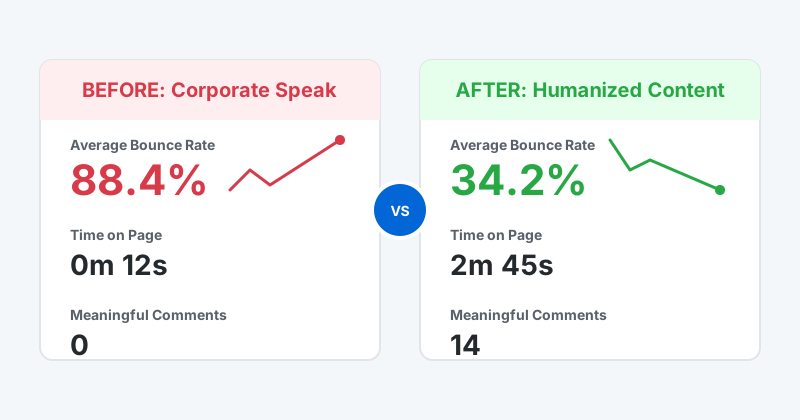
If people are bouncing the second they land on a stiff, formal announcement post, the data's basically screaming at you to change your tone. Our team walks clients through this exact kind of audit in our analytics and reporting services. It's usually the first thing we do before touching a single piece of content.
Pillar 2: Two-Way Communication - Stop Broadcasting, Start Talking
Social media stopped being a megaphone a long time ago. It's a conversation now, whether brands like it or not.
Good content invites people in. Those fill-in-the-blank posts, taking an actual stance on something, letting employees show up as themselves instead of a logo. Thats the stuff platforms want to see. Your comment section is basically free market research if you'd just read it.
Metrics that actually matter here:
- Comment-to-follower ratio
- Sentiment analysis (are people saying something meaningful, or just dropping emojis?)
- Social referral traffic — and specifically, how many of those visitors turn into a lead
If you're not tracking whether a conversational post leads to a form fill or resource download, you're missing half the story. Our social media management team tracks this stuff religiously so clients can see the line from "comment" to "conversion."
Pillar 3: Adaptability - Build a Culture That Doesn't Panic
Algorithms change. Consumer behavior changes. Your content strategy needs to be able to shift without a six-month committee meeting about it.
The move: A/B test your "humanized" content hypotheses. Small bets, not your whole ad budget.
Watch:
- Cost Per Acquisition (CPA)
- Return on Ad Spend (ROAS) on boosted posts
If a raw, unpolished iPhone video drops your CPA by 20% compared to your slick corporate ad, that's not a fluke — that's proof. Kill the underperformer, double down on what's actually working. This is basically the whole philosophy behind our paid social advertising work.
.svg)
Want a Closer Look at the Strategies We Use to Manage Ads?

Pillar 4: Meaningful Language - Ditch the Jargon, Keep the Data
"We are thrilled to announce" has never once made a customer feel something. Real talk: nobody reads that and thinks "wow, this brand gets me."
The move: Rebuild your buyer personas using the actual words your customers use — pull it straight from reviews, sales call transcripts, and social comments. Not the words you think sound professional.
Watch:
- Landing page conversion rate (industry average sits around 1%, so targeted, human-sounding content can blow that number out of the water)
- Click-through rate (CTR): does a warm, conversational hook beat a sales pitch? Almost always, yes.
Human language builds trust, and trust is unexplainably good for your bottom line. It just is, even when it's hard to point to the exact mechanism.
Pillar 5: Predictive Intelligence - Answer Questions Before They're Asked
Modern consumers are allergic to clickbait. They've been burned before, so they scroll past anything that smells like a trap.
The move: Get sales, customer service, and marketing in a room (or at least a shared Slack channel) and figure out what questions people are actually asking, then answer those proactively in your content.
Watch:
- Customer Lifetime Value (CLV)
- Lead quality: are leads from authentic social content closing at a higher rate than leads from generic search ads?
Full-funnel visibility here matters a ton, which is why we lean heavy on this in our conversion rate optimization services.
The Secret Weapon: UTMs Are Just Digital Coupon Codes
Okay, real talk moment. A lot of platforms bury or hide links (looking at you, Instagram), so marketers end up stuffing links into bios and comments instead. Fine. But how do you know if those buried links are actually doing anything?
Think of it like old-school direct mail. You send flyers to three neighborhoods. Neighborhood A gets "Coupon Code A," neighborhood B gets "Coupon Code B," and so on. When someone redeems a code, you instantly know which neighborhood was worth targeting.
A UTM tracking link is the exact same idea, just digital. It quietly tells your analytics platform whether someone came from a LinkedIn comment, an Instagram bio link, or a Facebook video. no guesswork required.
Why this actually matters to you: you don't need to understand the technical plumbing. You just look at the dashboard and make calls like:
- "LinkedIn is driving 80% of our actual sales — let's shift budget off Instagram."
- "Our behind-the-scenes stories generate twice the leads of our product announcements — let's do more of those."
.svg)
The Strategy to Win: Data-Validated Empathy
Most people now write the way AI writes due to the help of all their tools, like Grammarly constantly upgrading your spelling and grammar, ChatGPT building outlines, or Claude Cowork sending approval requests for responses to emails. You can't guess your way into "writing human." You test conversational copy, you track the behavioral signals (time on page, CTR, real interactions), and you tie every single one of those back to leads and revenue.
That's Data-Validated Empathy. Emotional connection and profitable analytics were never actually opposites. They just needed a way to measure success and a shared dashboard.
Ditch the corporate speak and stop guessing if your marketing works. Subscribe for weekly, data-backed strategies that actually drive ROI.

FAQs
Q: What is "Data-Validated Empathy"?
A: It's the idea that authentic, human-sounding content and hard analytics aren't opposites — you can measure whether your "human" content is actually working using metrics like CTR, sentiment, and CPA.
Q: What's a UTM link and why does it matter for social media?
A: A UTM link is a tagged URL that tells your analytics platform exactly where a website visitor came from (LinkedIn comment vs. an Instagram bio link.) It's how you figure out which platform is actually driving sales, and not just clicks.
Q: What metrics should I track for "humanized" social content?
A: Start with comment-to-follower ratio, sentiment analysis, social referral traffic, CTR, CPA, ROAS, and CLV. These connect engagement to actual revenue instead of just vanity numbers.
Q: Do I have to choose between being authentic and being data-driven?
A: No — and that's kind of the whole point of this post. You test human-sounding content the same way you'd test any ad creative, then let the data confirm (or kill) it.
 Social Media Marketing & Management,
ROI,
Social Media Metrics,
Social Strategy,
Social media updates,
data driven marketing
Social Media Marketing & Management,
ROI,
Social Media Metrics,
Social Strategy,
Social media updates,
data driven marketing