

When evaluating the expansion of a marketing team, a Chief Financial Officer (CFO) or Chief Marketing Officer (CMO) may assume that an employee's base salary represents the total cost of hiring an in-house social media manager. However, the true cost extends well beyond payroll. Employer taxes, operational overhead, and specialized software all add an estimated 20-35% to the base salary of an internal social media hire.
A closer look at the in-house vs. agency social media cost also reveals the risks of relying on a single employee to manage your brand's online presence. An unexpected departure can disrupt campaign scheduling, reduce audience engagement, and affect brand reputation. These disruptions can turn what initially appears to be a predictable staffing expense into an ongoing financial and operational liability.
Besides the amount incurred from salary and benefits, companies must also pay to hire and train new employees. According to research from the Society for Human Resource Management, replacing a non-executive employee costs an average of about $5,475 in recruiting and onboarding expenses. When combining the hiring costs with the ongoing expenses of providing employees with the tools and resources needed to do their jobs, the total cost of employing someone quickly becomes much higher than originally expected and can exceed the original budget.
Beyond direct compensation and talent acquisition expenses, companies must also pay for design software, analytics tools, advertising software, and other resources needed to support their marketing efforts. To reduce these growing costs, many businesses choose to work with social media management agencies instead of maintaining and growing their own in-house team. Agencies provide the software, equipment, and specialized expertise needed for content creation, paid media, and performance tracking and measuring social media ROI. By carefully reviewing these compounding costs, companies can determine the best way to allocate their marketing budget.
What an In-House Social Media Manager Really Costs
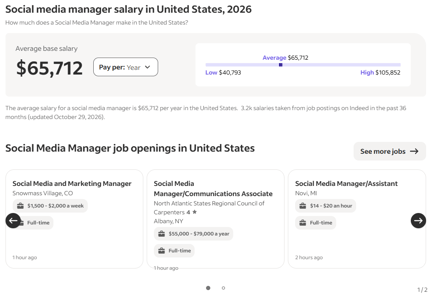
Many executive budgets evaluate an internal social media manager against a projected base salary of $60,000 to $75,000 per year. Indeed marketplace data puts the national average base salary for this role at $65,712. However, salary is only part of the employer's financial commitment. Businesses must also account for statutory payroll obligations, including Federal Insurance Contributions Act (FICA) taxes at 7.65% and Federal Unemployment Tax Act (FUTA) contributions at a standard net rate of 0.6% on the first $7,000 of taxable wages.
Pennsylvania employers face an additional obligation through the State Unemployment Tax Act (SUTA). The Pennsylvania Department of Labor and Industry applies unemployment compensation taxes to a $10,000 wage base, with new, non-construction employers subject to a standard contribution rate of 3.822%. These obligations add to the cost of employing a full-time social media manager, before accounting for benefits, equipment, and software. What initially looks like a manageable salary can become a substantially larger annual investment.
On top of compensation and payroll obligations, employers must also cover the equipment needed to support the position. Whether the employee works in-person, remotely, or in a hybrid arrangement, the business may need to provide laptops, monitors, and other essential office equipment. These initial purchases can range from $1,500 to $2,500, with additional costs for technical support, repairs, and future upgrades.
Social media managers also need software for scheduling, content creation, and campaign tracking. Whether a business uses platforms such as Sprout Social, Hootsuite, or Metricool, software licensing represents another recurring expense that must be factored into the total cost of an in-house hire. Add design and advertising tools, and annual software costs can reach $3,096-$6,216.
When salary, payroll obligations, benefits, equipment, and software are combined, the first-year investment in a single in-house social media manager can become a substantial financial commitment. For businesses deciding between hiring in-house or partnering with an agency, these additional expenses can significantly impact the true cost of social media management and the overall value provided by a dedicated agency team.
When Your Social Media Manager Leaves
A high marketing team turnover rate doesn’t just affect morale. It can have a significant financial impact on the business. According to workforce benchmarks from Pave, marketing experiences some of the highest voluntary turnover rates across all industries, reaching as high as 24%. When a social media manager leaves, the business feels it in more ways than one, extending beyond just the need to fill the role. This level of turnover can disrupt campaigns, audience engagement, and marketing momentum.
The real cost begins when it’s time to replace an employee. Research highlighted by Manatal estimates that replacing an employee can cost anywhere from 50% to 200% of their annual salary after accounting for recruiting, onboarding, and lost productivity. For specialized technical roles, this number is closer to 80% of annual salary. For a social media manager earning $65,712 per year, a single departure could result in more than $52,000 in replacement costs and lost productivity before a new hire is fully up to speed.
The longer a position remains unfilled, the greater the financial impact on the business. While older benchmarks estimated an average hiring timeline of 44 days, more recent data suggests that filling an open role can now take closer to 60 days. For a social media manager with a salary of $65,712, this vacancy translates into roughly $47,000 in lost business value while campaigns lose momentum and audience engagement declines.
Prolonged hiring timelines also make it harder to attract top talent. Research shows that 51% of top candidates abandon slow hiring processes with poor communication or long recruiting cycles. As a result, businesses have to eat the cost of an unfilled position while also potentially losing out on qualified candidates to other companies or even competitors.
Employee turnover is only part of the challenge. Social media marketing requires both creative storytelling and analytical expertise, yet few professionals master both. When businesses rely solely on a single in-house marketer to handle everything, they often run into the typical social media mistakes holding small businesses back, like underperforming campaigns, inefficient ad spend, and missed opportunities for growth.
Get More From Your Social Media Investment
For growing businesses, effective social media marketing shouldn't require absorbing the costs and risks of building an entire department around a single hire. Between employee turnover, extended vacancies, payroll expenses, benefits, software subscriptions, and training costs, the true investment is often far greater than the salary listed on a job posting. If an organization is exploring the agency route, understanding the key factors in hiring a social media agency can help ensure access to specialized expertise while avoiding the costs and risks associated with building an in-house team.
Don’t let turnover, hiring delays, and rising overhead slow your marketing growth. Partner with DaBrian Marketing Group for a fully managed social media solution backed by a team dedicated to helping grow your online presence. Instead of relying on a single employee, gain a trusted marketing partner that provides the strategy, content creation, and campaign execution needed to deliver consistent results.

 Marketing Budgeting,
social media agency,
Social Media Manager Cost,
In-House Social Media Manager,
In-House vs Agency Social Media,
Social Media Outsourcing,
Employee Turnover Cost,
Social Media Management Cost