

Your dock doors are the product. Your racking is the product. Everything else is overhead.
So when a regional manufacturer decides to move off their current provider and starts looking for cross-docking capacity in your market, the only question that matters is whether your name appears anywhere in that process. Not whether your homepage is pretty. Whether you exist in the places that shipper is looking.
For most freight and warehousing operators, the honest answer is no. The pipeline came from referrals, broker relationships, and the occasional RFP that landed because somebody knew somebody. That worked. It works less well now, and the gap is getting harder to ignore. We wrote about this shift in more detail in Stop Relying on Handshakes to Grow Your Factory, and the dynamic is nearly identical on the logistics side.
What Actually Happens Before a Shipper Contacts Your Facility?
Almost everything.
Gartner's B2B Buying Survey found that buyers spend only 17% of their total purchase time meeting with potential suppliers. Spread that across a competitive shortlist and any single provider might get five or six percent of a buyer's attention. Roughly 27% of their time goes to independent online research, which means they are learning about you without telling you they are learning about you.
It gets less comfortable. 6sense's 2024 Buyer Experience Report found that 81% of B2B buyers already have a preferred vendor at the time of first contact, and 85% have largely established their requirements before they reach out to anyone. The average buying cycle in that same research ran 11.3 months.
Read that again with your sales cycle in mind. Somebody has been evaluating your facility for the better part of a year. They have compared your square footage to a competitor's. They have looked for your certifications. They may have decided against you in month three and kept you on the list for negotiating leverage. Your CRM shows nothing, because there was nothing to show.
By the time the phone rings, the decision is mostly made. Your marketing either did its job during those silent months or it did not.
What Does a Shipper Actually Find When They Look You Up?
This is the part most operators have never checked.
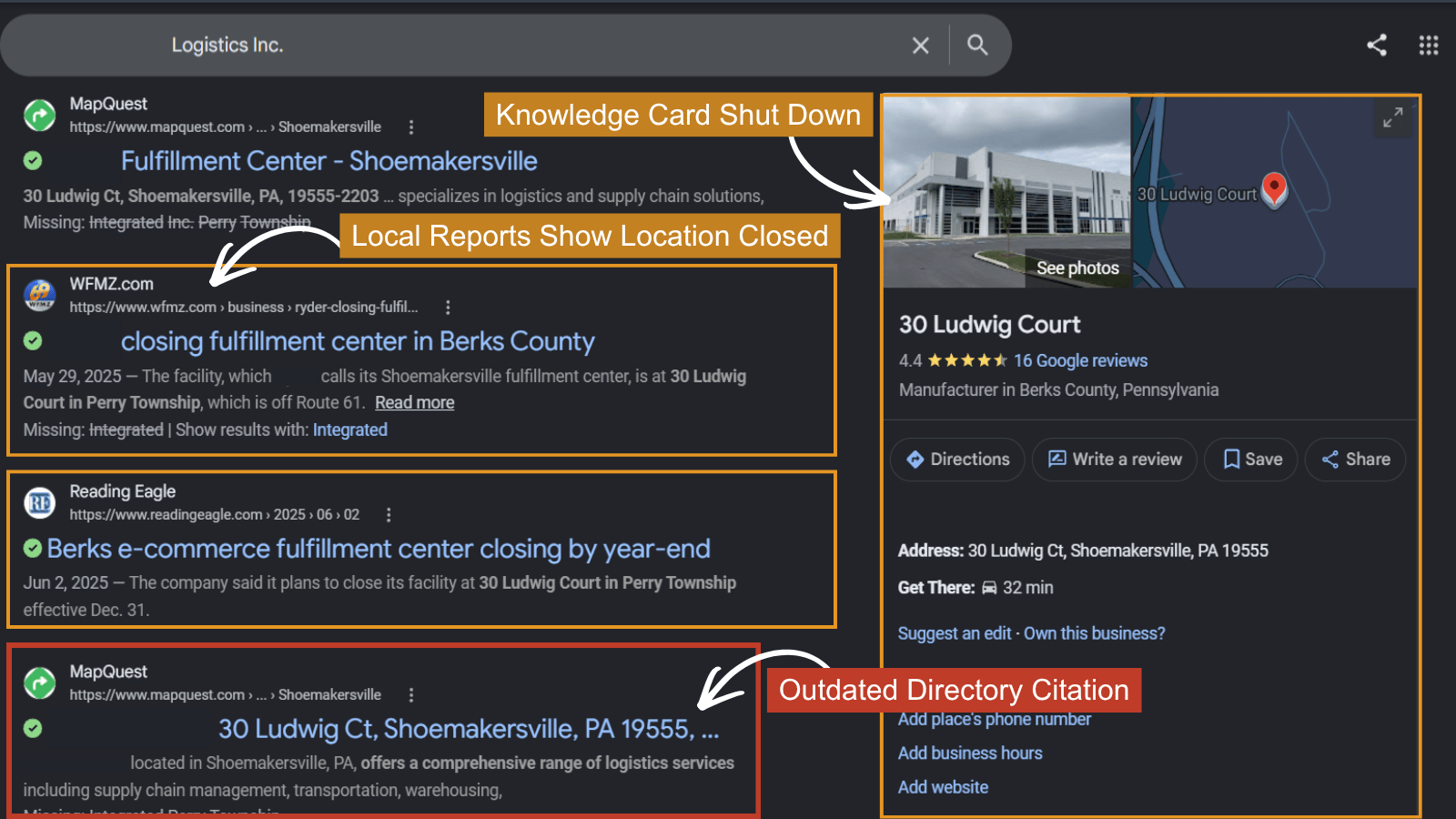
Type your company name into an incognito window and look at the entire first page. Not your website. The whole page. That collection of results is what a buyer sees during the research window, and you probably control less of it than you assume.
Common findings when we run this on logistics clients:
- A Google Business Profile for the headquarters and nothing for the satellite terminal that opened two years ago
- A profile for a facility the company vacated in 2021, still live, still collecting direction requests
- A primary business category set to "Storage Facility" or "Moving Company" instead of a logistics category, which quietly excludes the business from the category searches that drive most local discovery
- Gate addresses, dock addresses, and suite numbers that disagree across Google, Apple Maps, Bing, and the chamber directory
- An industry directory listing with an address that has been outdated for years
- Reviews from drivers or former employees that have nothing to do with service quality but are the only reviews present
None of that is a branding problem. It is a data problem, and data problems are fixable in weeks rather than quarters. The reason they persist is that nobody owns them. Operations assumes marketing handles it. Marketing assumes the web vendor handled it at launch. The web vendor built the Google Profile in 2019, shut it down when you moved, has not logged in since.
Why Doesn't Your Second Facility Show Up in Local Results?
Because Google does not know it exists as a distinct location.
Geography is the first filter in freight and warehousing. A shipper looking for port drayage near Norfolk is not going to consider a terminal in Ohio no matter how good the rate is. Queries like "warehouse near me," "LTL shipping [metro]," and "cross-docking services [state]" resolve to a map pack before they resolve to blue links, and the map pack is built from listing data rather than from your website copy.
Google's own published research on Business Profiles is consistent on this point.
Complete profiles generate roughly 70% more location visits than incomplete ones, and consumers are about 2.7 times more likely to view a business as reputable when the profile is fully filled out.
Those figures come from consumer behavior studies, so treat them as directional for B2B. The mechanism still holds. A facility with no profile, a miscategorized profile, or a profile with no photos is competing at a structural disadvantage against a competitor down the road who spent an afternoon on it.
Multi-facility operators feel this hardest because the problem multiplies. Five terminals means five sets of listing data, five categories, five sets of hours, and five opportunities for a discrepancy that suppresses all of them.
How Do AI Search Tools Decide Which Logistics Provider to Recommend?
They read the same data layer.
6sense found that 94% of B2B buyers used generative AI tools somewhere in their purchase process.
When a logistics manager asks ChatGPT or an AI Overview for bonded warehousing options near a specific port, the answer gets assembled from structured business data, verified listings, directory presence, and review signals. It does not get assembled from your hero image.
This is the useful part for anyone who has been told that AI search requires some entirely new discipline. It mostly does not. The inputs that make you findable in a map pack are the inputs that make you citable in a generated answer. Incomplete listing data makes you invisible in both places at once, which means the cleanup work pays twice.
If you want the broader framework for how this fits into a B2B program, our business-to-business marketing library covers the surrounding strategy.
Why Do Google Ads for "Warehousing" Burn Budget So Fast?
Because the keyword is contaminated at the source.
Bidding on "fulfillment" or "warehousing" pulls in consumers tracking packages and people looking for warehouse jobs. Both groups click. Neither group has freight to move. You can build a negative keyword list, and you should, but you are fighting the fundamental ambiguity of the term rather than fixing it.
There is a second problem that negative keywords cannot touch. If a buyer has already been researching quietly for six months and has already formed an impression from what they found, paid traffic sends that same person back to the same page that did not convince them the first time. You are paying for a second look at an unchanged asset.
None of this means paid search is wrong for logistics. Tightly scoped campaigns around service plus geography plus intent can work well. It means paid search is the wrong first move when the underlying discoverability is broken, because you will spend real money to confirm that it is broken. Get the free surface fixed, then buy the paid one. We covered the sequencing question in How to Stop Your B2B Sales Pipeline From Drying Up.
Should You Market Your Facility as a Generalist?
Probably not, and this is a marketing argument as much as a positioning one.
"We handle all your logistics needs" is unrankable. There is no query behind it, no category to occupy, and nothing for an AI system to cite you as being good at. It also puts you in a rate conversation with every other provider in the region, which is a conversation nobody wins.
Specificity does double duty. A provider known for temperature-controlled LTL, or hazmat-certified storage, or oversized freight handling, or bonded facilities near a specific port, has something a search engine can index and something a buyer can shortlist. It narrows your addressable market and raises your close rate inside it. Operators who commit to a lane tend to stop competing on price, because there are fewer people in the lane.
Pick the thing you are genuinely better at and build your service pages, your listing categories, and your directory entries around it. That is the cheapest differentiation available to you.
What Should You Check This Week?
Sixty minutes of work, no vendor required:
- Search your company name in an incognito window and screenshot the full first page. That is your brand SERP.
- Confirm every active facility has its own claimed Google Business Profile with the correct primary category.
- Search your address on Google Maps and look for duplicate or closed listings you did not know about.
- Pull your business name and phone number from your website, then compare against Bing Places, Apple Maps, and any industry directory you are listed in.
- Ask an AI search tool for providers offering your primary service in your market and see whether you appear.
If all five come back clean, your discoverability is in better shape than most operators in this industry and you can move on to demand generation. For related reading on how shipper-side buyers behave, Unlocking Success in B2B Ecommerce Marketing covers the buyer psychology in adjacent detail.
Get a Free Business Listing Scan
If you would rather see all of it in one report, we will run it for you.
DaBrian Marketing's free listing scan checks every facility you operate against the major mapping platforms and directories. You get a report showing which listings exist, which are duplicated, which are miscategorized, which have conflicting contact data, and which facilities are missing entirely. You also get a read on what your brand SERP looks like to a shipper in the middle of a quiet evaluation.
No call is required to receive the report. If you want to talk through the findings afterward, we are happy to. If you want to take the report and hand it to your own team, that works too.
Run a Free Business Listing Scan and find out what a shipper sees before they decide whether to call you.